












GPA and STILL: An Alliance Serving the Circular Economy!
 InfoWeb Marketplace · Editorial team
Published on 8 March 2026 · 5 min read
The recycling of end-of-life vehicles (ELVs*) is now a major environmental challenge. It makes it possible to recover existing materials, reduce the amount of waste and limit the extraction of new natural resources.
A major player in the treatment of end-of-life vehicles (ELVs), the GPA group works with all French insurance companies. With turnover of 95 million euros in 2025, the family-owned company has established itself as a benchmark in the automotive circular economy. This report takes us to one of its three centers, the one in Pont-Sainte-Maxence, in the Oise department, operational since August 2025 and the group's newest site.
Founded in 1962 in the Drôme department, GPA has established itself over three generations as an essential player in the sector. The group now has 400 employees and three centers in operation, and collaborates with all French insurers. GPA processes more than 37 000 vehicles per year. Commissioned in August 2025, the Pont-Sainte-Maxence site completes the territorial network formed by the centers in Livron, in the Drôme, and Angers, in Maine-et-Loire.
Its logistics and intralogistics design was developed in partnership with STILL, in order to support the site's ramp-up and its requirements for traceability and performance. Spread over 10 hectares, it includes a 15 000 m² building and fully reflects the purpose of the mission-driven company: ?recycling mobility into a desirable and supportive future?. In time, this site will be able to process up to 40.000 vehicles per year.
Impeccable traceability and logistics
Since the AGEC law of 2020, the management of ELVs has been strictly regulated in order to promote the circular economy. These regulatory requirements impose strict standards on approved centers for the treatment and recovery of end-of-life vehicles. For GPA, this means impeccable logistics and traceability.
When an insurance company contacts GPA, the company has 24 to 48 hours to collect the vehicle. One of the group's 200 logistics partners then carries out the collection and temporary storage, before one of the 37 trucks of the subsidiary GPA Transport takes over. ?This organization allows us to consolidate flows and reduce the number of trucks on the roads,? explains Lionel Daronnat, Operations Director.
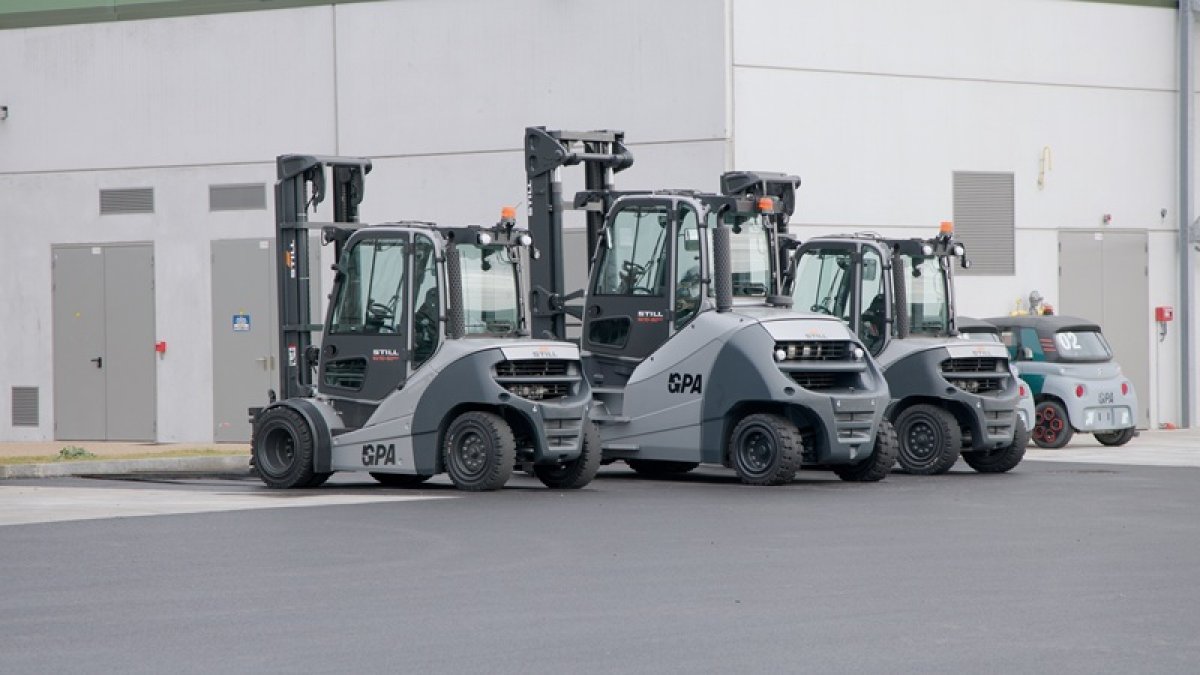
On arrival at the Pont-Sainte-Maxence site, the vehicles are handled by a complete intralogistics system supplied by STILL, from unloading to storage and shipment of parts. The vehicles are unloaded by one of STILL's RX70-50 and RX 70-80 internal combustion trucks (5 and 8 tonnes), then parked in the outdoor yard. A R07-25 tractor fitted with trailers then makes it easier to move them, especially when the storage area is far from the unloading point.
The vehicles remain immobilized for at least 60 days in a car park of 1 954 spaces, of which 840 are spread across five-level cantilever racks, while the administrative procedures are completed.
?On receipt at our site, the operators take 27 photos of the vehicle from every angle, accessible via the QR code assigned to it on arrival,? explains Julien Morichon, Operational Site Director of GPA 60. ?These photos notably make it possible to determine which operations can be carried out on our dismantling lines.?
The vehicles received are dismantled in order to recover their parts, which are then resold to professionals and individuals via the group's website and a call center. For electric vehicles, which are increasingly numerous, the battery is removed beforehand, made safe and stored in a suitable area.
A succession of dismantling stages
Once placed on the dismantling line, each vehicle follows a precise process. At each stage, the QR code is scanned, telling the operator which tasks to perform. A specific QR code is also generated for each dismantled part, giving access to its complete history: original vehicle, condition, mileage, etc.
The technicians have a digital library detailing the dismantling procedures. ?With thousands of different models, there are as many ways of dismantling a vehicle, and not everything can be memorized,? points out the site director.
Dismantling begins with the removal of the wheels. The rims can be resold as they are or recovered at the price of the material, while the tires go to a recovery channel. The battery of internal combustion vehicles is then removed, followed by the opening parts (doors, hood, trunk, etc.). Then comes the essential depollution stage, with the extraction of all fluids. ?This is an obligation linked to the approval issued by the State,? Julien Morichon points out. ?Each fluid is drawn off using a dedicated hose. Refrigerants are declared to Ademe and resold to specialized stations, while gasoline is reused to fuel our internal combustion trucks.?
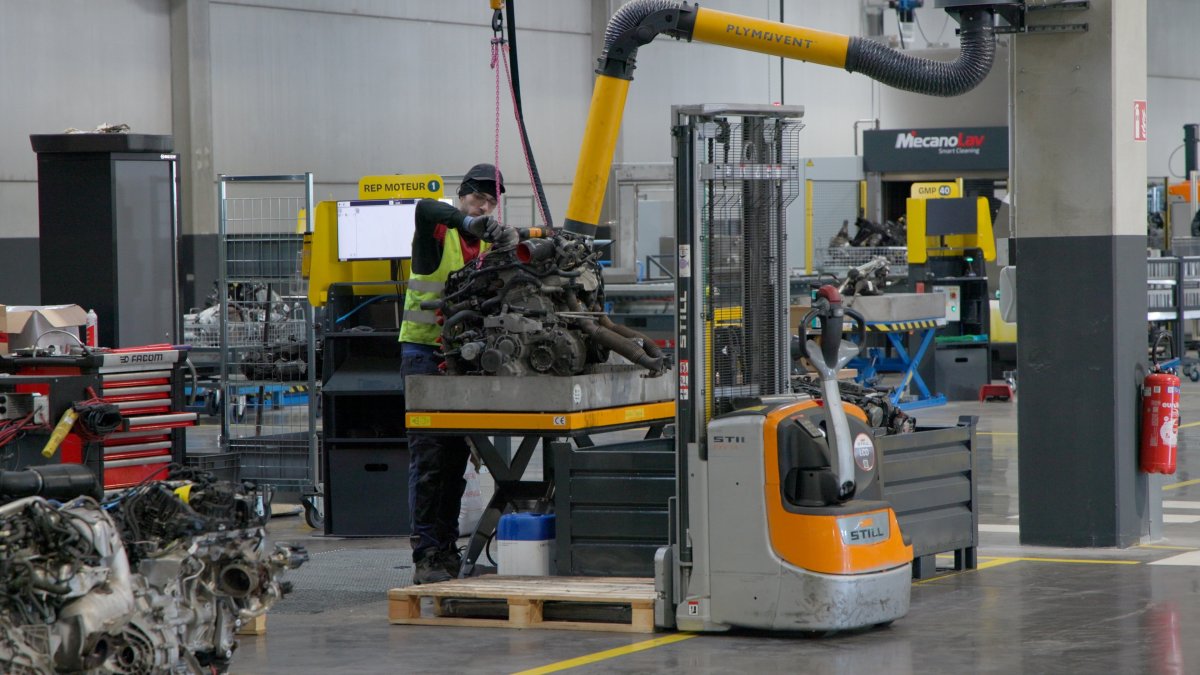
The vehicle is then turned over in order to extract the powertrain. This is transferred to another line by one of STILL's EXV 14 C electric stackers, then dismantled, washed and photographed in a 3D studio. At the end of the line, a check ensures that all reusable parts have been removed. The remaining shell is taken by one of the three STILL RX20-20 electric trucks to a compactor, before being sent to a shredder or to one of the 24 Paprec skips located around the site.
Optimized stock placement
?What really made the difference on the GPA Pont-Sainte-Maxence project was teamwork,? explains Clément Juillard, Systems Sales Engineer at STILL. ?From the outset, our sales, technical and service teams worked hand in hand with the GPA teams to understand their flows, their regulatory constraints and their circular economy objectives. This close collaboration enabled us to design a logistics solution that is coherent, scalable and perfectly integrated into the site's operations.?
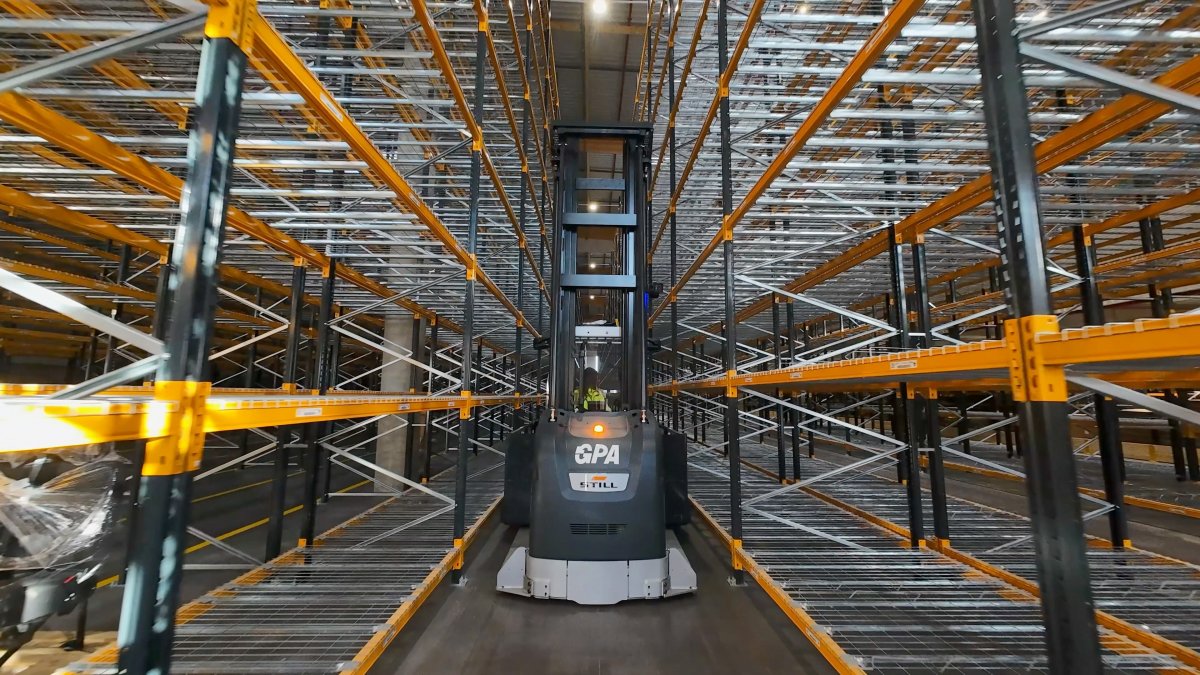
Each dismantled part is checked, cleaned, photographed and identified by a QR code tracing its origin and history. It is then packed – from around ten different carton formats – before being stored. The parts are placed in one of the 10 000 racking locations supplied by STILL, while the smallest ones are stored in an AutoStore supplied by Dematic with 15 000 bins, installed on a mezzanine of 800 m², able to hold 150 000 parts in time.
In the narrow aisles, STILL MXX three-way trucks handle storage. Order picking is then carried out using PXV high-level order pickers, and the orders are taken to the shipping area, where an EXH-S pallet truck loads the trucks.
This organization relies on intralogistics designed from the outset, capable of absorbing the site's ramp-up, a key point of the partnership forged with STILL.
The GPA Pont-Sainte-Maxence site is able to ship up to 1 500 parcels per day (on average, an order consists of 1,04 part). It offers nearly 150 000 parts in stock.
Sold for 50 to 90% less than new manufacturer parts, and guaranteed for two years, GPA used parts fully embody the principles of sustainable development. Driven by European and French circular economy objectives, the company is expected to continue its growth in the coming years.
By combining technical expertise, rigorous traceability and innovative logistics solutions, GPA and STILL demonstrate that it is possible to reconcile industrial performance and environmental responsibility. The Pont-Sainte-Maxence site perfectly illustrates this ambition: every vehicle processed becomes a resource, and every part recovered helps reduce waste and preserve natural resources. With this approach, GPA confirms its role as a pioneer in the circular economy of the automotive sector, offering a sustainable and accessible solution for the recycling and reuse of end-of-life vehicles.
*ELV: vehicles that have reached the end of their useful life, either because they are no longer roadworthy or because restoring them would be economically unreasonable.