












capaNCDT 6220 Micro-Epsilon, a modular controller for precise measurements
 Micro-Epsilon France
Published on 25 May 2018 · 1 min read
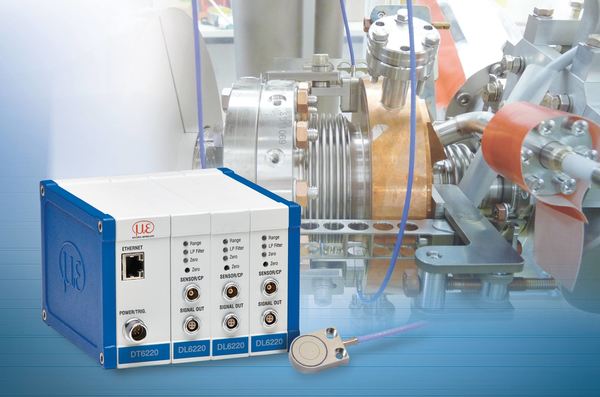
Micro-Epsilon's highly precise capacitive sensors are used in the development of accelerator technologies. For these measurement tasks, the Helmholtz Zentrum Berlin (Helmholtz Centre Berlin for Materials and Energy) uses flat-type sensors with a modular capaNCDT 6220 controller. The capacitive measuring system delivers precise measurement results under extreme environmental conditions, such as temperatures approaching the physical limit.
As part of the development of accelerator technologies, the Helmholtz Zentrum Berlin is using the "bERLinPro" project to develop an ?Energy Recovery Linac? (linear accelerator with energy recovery) based on a new technology. To do so, it relies on Micro-Epsilon's precise measurement technology, namely flat-type sensors combined with a modular multi-channel capaNCDT 6220 controller. The measuring system can easily be extended to up to four channels and is therefore suited to the most flexible applications. The tilt and the change in position of the holder during cooling from room temperature to 2 K (-271°C) are thus recorded.
To optimize the source of the electron bunches to be accelerated, a photocathode is introduced into a superconducting radio-frequency electron gun. The electron bunches generated in this way remain more compact during subsequent acceleration than those from other sources and can, among other things, be used to obtain higher-quality X-rays.
The requirements placed on the measuring system used are strict. The robustness of the capacitive capaNCDT 6220 measuring system against harsh environmental conditions makes it ideally suited to this measurement task. Low temperatures close to the physical limit, ultra-high vacuum, continuous X-ray bremsstrahlung and weak interfering high-frequency fields create a demanding environment. Micro-Epsilon's sensors meet the requirements regarding sensor design as well as thermal resistance and long-term stability. Sensors with a measuring range of approx. 4 mm handle the measurement task, which requires a linearity of 10µm. The sensors achieve a resolution of 0,1 µm. Thanks to its modular architecture, the three measuring points can be recorded with just one controller. The results are transmitted via an Ethernet interface.
