




Description
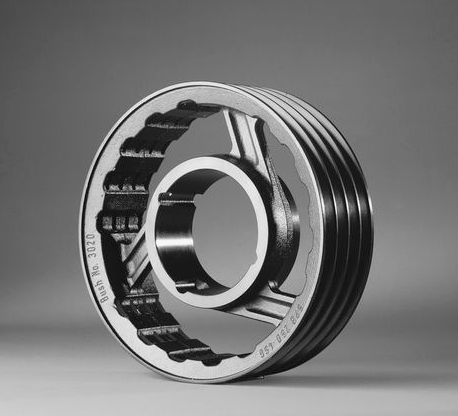
The VTP pulley is a grooved pulley for V-belts with an entirely new design that meets all aspects of performance optimization for grooved pulleys for V-belts.
One of the improvements to highlight is that, by combining the design with high-quality cast iron, it has been possible to reduce the weight of the pulley by up to 50% compared with conventional grooved pulleys for V-belts. In addition, the geometry of the arms significantly reduces the internal stresses present in the pulleys.
High wear resistance thanks to the quality of the cast iron GGG 60, which provides resistance up to 2,5 times greater than that of standard pulleys and makes it possible to increase the linear speed of the pulleys.
Greater power transmission
Thanks to the ventilated grooves, V-belts operate at a lower temperature (up to 17° C) than when standard pulleys are used. This has a significant impact on extending the useful service life of the belt (see figures above).
The ACC surface treatment (cathodic dip painting) is a new, more effective surface treatment for cast iron. The process gives the surface, among other things, a high degree of resistance to oils, petrol, brake fluids, lubricants, etc.
After exposure to salt spray for 480 hours, the surface condition of the pulleys is between Ri 0 and Ri 1 (NF EN ISO 4628-3 – rusted area less than 0.05%), confirming very good rust resistance.
This process also provides good physical properties under mechanical influences (pencil test 6H), and a coating and/or paint can be applied directly to the ACC-treated surface. It is also a very environmentally friendly process.
Extends the service life of V-belts thanks to ventilated grooves that ensure a lower operating temperature (10° C to 17° C).
A lower weight means a reduction in the moment of inertia. Logistics costs are also reduced.
Made of nodular cast iron with a new design that guarantees lower stresses in the pulley
VTP pulleys allow V-belt drives to be used at higher ambient temperatures.
They are impact-resistant, which reduces the risk of damage during transport and assembly.
The peripheral speed can be more than doubled (up to 100 m/s).
Technical specifications
| Category | Power transmission, Mechanical components |
|---|---|
| Subcategory | Mechanical transmission |