












BASF simulation for early detection of thermal deformation
 InfoWeb Marketplace · Editorial team
Published on 29 March 2018 · 2 min read
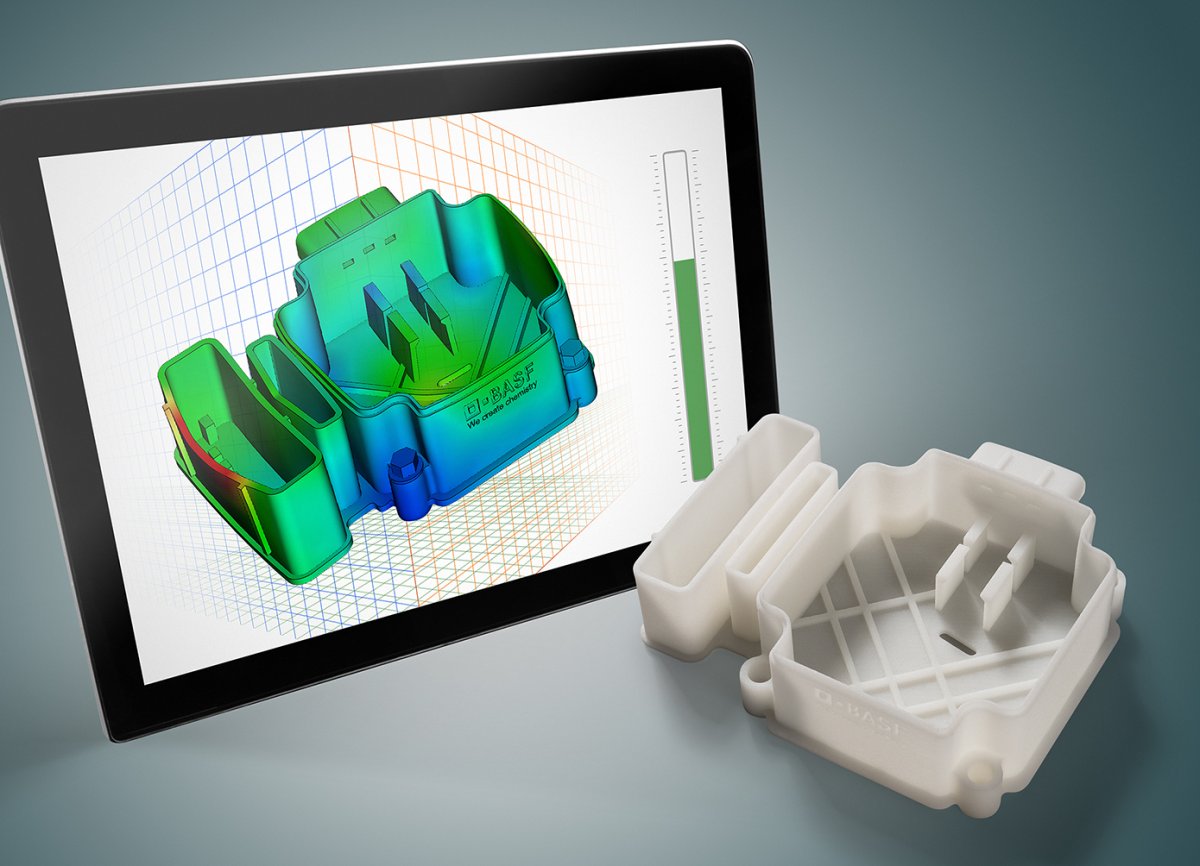
BASF is offering a simulation module for injection-molded component applications: a thermomechanical module for fiber-reinforced thermoplastics that makes it possible to run simulations and thus obtain accurate predictions of deformation as a function of temperature. BASF is now offering a new simulation module for injection-molded component applications. BASF's Ultrasim simulation tool is renowned for accurately calculating the anisotropic mechanical behavior of fiber-reinforced plastics after processing by injection molding. The tool has just been enhanced with an additional function: a thermomechanical module for fiber-reinforced thermoplastics that makes it possible to run simulations and thus obtain accurate predictions of deformation as a function of temperature.
Thanks to the main advantage of this innovation, customers can now identify potential weak points virtually during the development phase itself, and avoid them before series production even starts. The new module takes into account the complex thermomechanical material behavior, the impact of the anisotropic fiber orientation, as well as the temperature distribution and the changes within the component.
?During the initial development phase, it is essential to make detailed predictions for the finished product,? explains Andreas Wonisch, simulation expert at BASF. ?Particularly for high-performance plastics used in automotive applications and exposed to enormous temperature variations, it is imperative to predict potential deformations.?
Fiber-reinforced plastics exhibit very complex thermodynamic behavior. When subjected to thermal stress, undesirable deformations can occur depending on the local temperature and the fiber orientation in the component. The phenomenon is particularly critical for electronic and electrical components with integrated switches. Ultra-sensitive electronic components must not be damaged under any circumstances. Accurately predicting thermal deformation through prior simulation with Ultrasim brings a double saving in the development process: the manufacturer saves time and money.
An integrative simulation approach with Ultrasim
Through extensive measurements taken directly on the material and on injection-molded test specimens, Ultrasim provides a full characterization of materials across the entire temperature range. Instead of running the simulation at a single temperature, it is possible to recalculate the typical thermal stress between -40 and 150°C for different applications. The influence of the fiber orientation in the component, which determines the anisotropic thermomechanical behavior, is taken into account by integrating process simulation.
The simulation carried out in this way is far more comprehensive because it takes into account not only the rheological and thermal properties but also the fiber orientation resulting from injection molding. This rigor makes it possible to identify component defects and avoid them from the initial phase. BASF already uses this calculation model for a large number of applications, primarily in the automotive sector.
Automotive manufacturers benefit from simulation accuracy
Electric mobility represents a major challenge for the automotive sector, which is currently developing innovative new components to protect ultra-sensitive parts such as conductor tracks, sensors or printed circuit boards. Given the considerable temperature differences, components must not deform under any circumstances, as they could damage the electronic systems. The new Ultrasim module has already proven itself successfully for various parameters in several customer projects, including an electronic control system. The simulation of thermal expansion for electronic control unit (ECU) housings showed very good agreement across the entire temperature range studied. Other envisaged uses for the simulation tool include plastic headlamp components using power electronics that generate high heat dissipation.