












Editorial team · Robotics, Automation, Industrial IT
 InfoWeb Marketplace · Editorial team
Published on 9 September 2013 · 1 min read
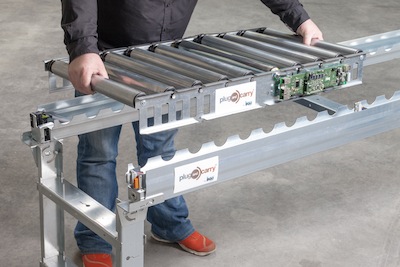
Boa Concept supervisor for modular conveyor
InfoWeb Marketplace · Editorial teamPublished on 9 September 2013 · 1 min read
The modular conveyor is a mechanical concept. Boa Concept has invented the logical concept that goes with it: a supervisor that automatically recognizes the topology of the circuit the user builds on site.
In plain terms: you simply connect the conveyor elements to one another, and the supervisor takes care of the rest. There is no need to configure the conveyor elements and no need to indicate the position of each element in the circuit; the supervisor discovers it on its own.
The supervisor's second major feature: it can automatically find the best path to take a load (a parcel or a tote) from one point to another.
To do so, it naturally takes the topology of the circuit into account, like a car navigation system, but it also takes saturation into account.
Thanks to automatic circuit recognition and automatic load routing, the supervisor becomes a true standard program that does not need to be reprogrammed to take a circuit modification into account: it will discover the modification on its own and, above all, it will automatically change the automation rules to be applied in order to make use of these modifications.
The user therefore does not need the manufacturer's technical teams to make line modifications, and if they wish, they can even carry out their first installation entirely on their own.
This is a turning point in the world of mechanized order-picking systems: it becomes possible to modify one's installation regularly, in the same way that one regularly reconsiders one's picking layout, and also to set up temporary structures for the needs of an atypical contract or a promotional operation.
The user can thus envisage building dedicated lines for certain projects, within a short lead time that meets their need for responsiveness.
They can carry out their own changes, as the supervisor recognizes the modifications.
Advertisement