












CoroDrill® DS20 drills - Seven years of development
 InfoWeb Marketplace · Editorial team
Published on 23 October 2019 · 3 min read
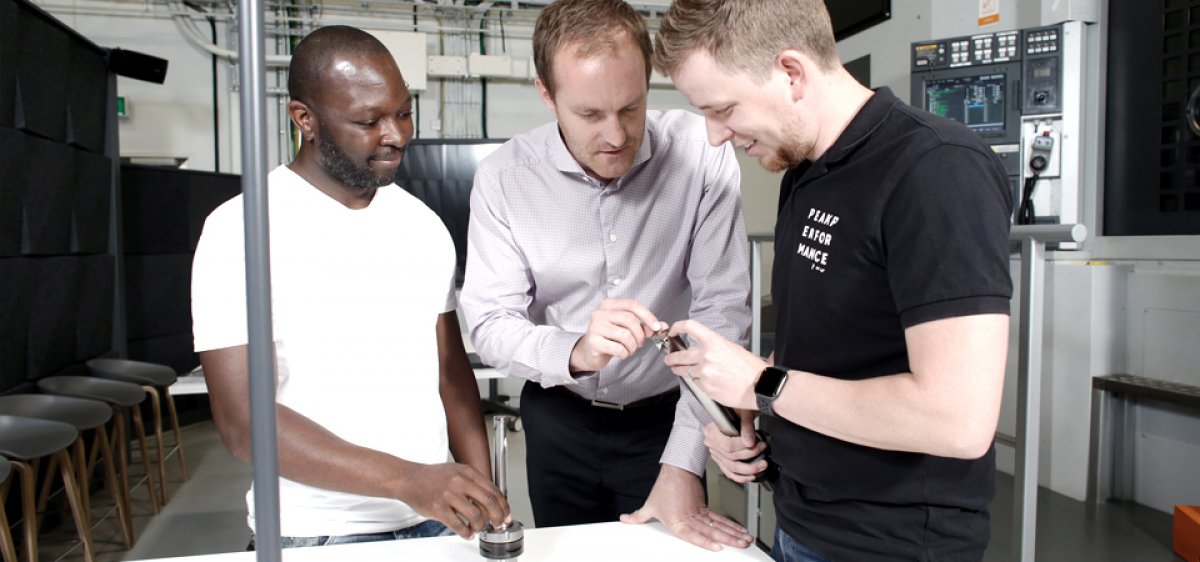
It takes an entire team of seasoned technicians to carry out a project such as CoroDrill DS20, and it took almost seven years for the developers to be satisfied and agree to launch on the market the longest and most reliable indexable insert drill available today.
This is not just any indexable insert drill, because this tool can drill holes to a depth of seven times its diameter in a single pass without deflection and without overheating. Seven years ago, when Sandvik Coromant began to consider the possibility of making an indexable insert drill for a drilling depth of 7xD, the first of its kind on the market, nobody suspected how much work it would take.
?Fortunately, we are passionate about engineering and no member of the team ever gave up, even though we went down the wrong path several times or faced unexpected obstacles,? says Håkan Carlberg, the project manager. ?Challenges like this are very motivating, and personally I was convinced that we would reach our goal.?
Carlberg was right. In October 2019, Sandvik Coromant will launch the first item in a program of 256 CoroDrill DS20 drill bodies.
The CoroDrill DS20 bears very little resemblance to its acclaimed predecessor, CoroDrill 880. Instead of forming a traditional constant-angle spiral, the flutes of the CoroDrill DS20 are variable, starting with a helix and continuing in a straight line along the drill body. This is one of the many sophisticated features developed to optimize performance while promoting stability and balance of the forces of this long, asymmetric tool.
Every detail of the CoroDrill DS20 was the subject of extensive research, and as much time as necessary was devoted to its development. Research engineer Tomas Furucrona shows us a small insert whose optimization took two years. ?The first major challenge was determining the right shape and positioning to obtain optimal net force, given that the two inserts of the drills are positioned asymmetrically.?
The development of the drill body was carried out in parallel by a specialized team that studied, tested and analyzed its geometry, its coolant system and the material it is made of in order to find the ideal combination.
?Anyone can make a 7xD drill with a specific diameter,? says research and development engineer Fritz Alum Yah, who worked on the project from the start. ?But achieving the same reliability with a complete range of drill body diameters is another story. We had to develop new ways of thinking and create new calculation methods.?
There were many obstacles to overcome. There were many failures during laboratory tests. Countless prototypes were destroyed. Many ideas were explored and then abandoned. The challenge posed by the shape of the flutes and the presence of the internal coolant supply channels took two years of work to solve. And there were some fifty other parameters to be adjusted to one another. Changing one parameter meant revisiting the 49 others.
?We knew we were heading in the right direction when our calculation engineer Ramus Hemph, a talented scientist, developed a formula that gave us control of all the parameters,? says Carlberg. ?Where we thought in physical terms, he saw numbers and vectors. Software modeling allowed us to control, modulate and analyze all the parameters virtually. From there, everything fell into place.?
Even so, new challenges arose. The capabilities of the CoroDrill DS20 were tested in the field at the SKF plant in Mexico, where slewing rings for wind turbines are produced.
?By replacing the competing 6xD drill with the CoroDrill DS20, SKF operators were able to machine all the holes in the parts without unpredictable interruptions, without problems and without even having to index the inserts,? says Furucrona. ?Productivity was doubled and the operators were extremely satisfied.?
But for the development team, there were still details to sort out. ?We drew up a list of 15 issues, mostly production-related, that we would have to solve in 2 months,? says Carlberg. ?We succeeded. It's in our DNA to always look further to perfect new solutions and innovations.?
The development of the CoroDrill DS20 was an international collaborative effort. Most of the team was based in Sandviken, but it was supported by more than 50 people located in Gimo and Västberga in Sweden, as well as in Mebane in the United States.