












Eichenberger innovates with new type F recirculating ball screw
 InfoWeb Marketplace · Editorial team
Published on 29 October 2017 · 3 min read
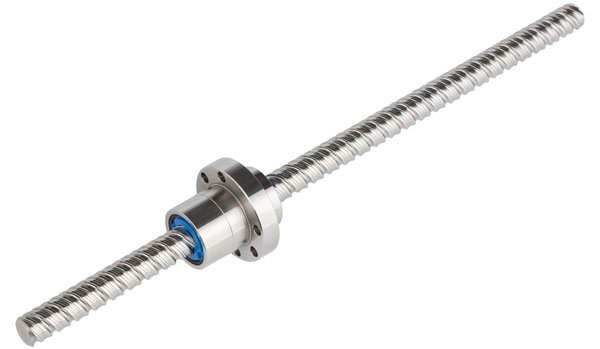
At Eichenberger, fast collaboration between the company's departments and a modern machine fleet allow maximum flexibility while strengthening the innovation process. The engineers at Eichenberger Gewinde have developed a new, efficient manufacturing process that makes it possible to produce a special nut with an extremely sophisticated recirculation system in a single work cycle. The new type F ball screw, a development of the Carry recirculating ball screw, was born. Eichenberger's manufacturing expertise offers real advantages, such as responsibility, know-how and availability. The simplicity of the design combined with an ideally suited manufacturing process offers a clear price advantage for an overall solution offered to the customer.
Older models rethought
The load transfer in a ball screw takes place from the screw to the nut by means of the balls. The mechanical efficiency, normally 0,4 at most for a trapezoidal screw, is greater than 0,9 for Eichenberger's CARRY recirculating ball screws. The associated energy efficiency makes the threaded screw one of the most widely used drive components. The nut is equipped with a recirculation system that returns the balls to their initial position.
In the new type F ball screw (CARRY model), the balls leave the threaded channel of the nut according to the recirculation system and are received by a special, high-precision recess in the notch, then recirculated and returned through the body of the nut. In the cap, the balls are recirculated again into the threaded passage, where they are aligned to perform their load transfer task with low rolling friction. The balls must absolutely roll smoothly and quietly as they pass from the nut into the recirculation channel. And they do. The innovative design of the nut body combined with ultra-modern, fully automated manufacturing methods results in a product with a very optimal cost.
The cold-rolled type F lives up to its promises
In a competitive market, a customer always chooses the supplier that offers the best advantages. The current trend is toward smaller screws with larger leads, and these are called ?square? screws (lead = screw diameter) and even ?oversquare? screws. In the new type F recirculation system, the screws are available with diameters from 6 to 40 mm and a lead from 2 to 40 mm. The ball recirculation element made of high-performance synthetic material integrated into the type F was developed for high-volume production and can be produced at a very attractive price thanks to the economical manufacturing process. Behind the quality features lie endurance tests at maximum speed and loads. They confirm the excellent performance of the new recirculation system.
The core competencies of Eichenberger Gewinde AG are thread rolling and hardening. The increase in strength resulting from cold forming is not as important in the manufacture of ball screws as it is for sliding screws. The continuity of the ball screw profile, transferred by the full profile onto the extremely stable thread-rolling tools on the screw, is far more decisive. The very fine, compact surface of the profile is just as important. This fineness (roughness value ~ Rz 1.0) offers a small surface for dirt to attack and also guarantees quiet rolling of the balls. The smooth rolling surface and the rolling motion of the balls reduce wear and considerably increase efficiency. This in turn allows a low drive torque with low self-heating. This reduction in drive power thus reduces operating costs.
With long experience in internal induction hardening, Eichenberger has built up extensive know-how. Unlike hardening companies that limit themselves to hardening steel, the thread specialist seeks to achieve the best possible combination of hardness and precision. This is decisive for the lead accuracy of the ball screw across the impressive multitude of diameters. Especially for small dimensions, this challenge has to be mastered, because the smaller the diameter, the more skill and intuition hardening requires. Previously, such precision could only be achieved on screws shaped on a grinding machine.
