
Emerson's New Ultrasonic Welding Platform for Faster Welding
 InfoWeb Marketplace · Editorial team
Published on 12 February 2019 · 3 min read
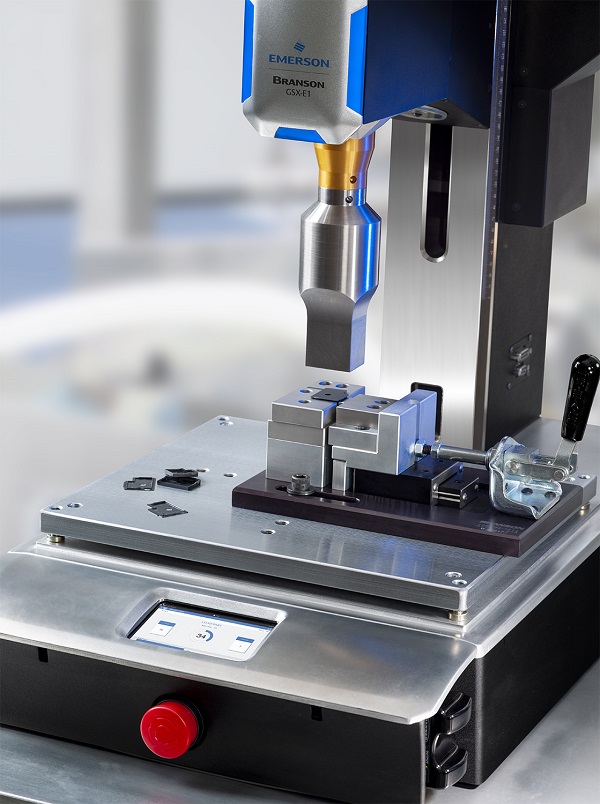
Emerson's new ultrasonic welding platform meets the challenge of assembling small, critical plastic parts - The GSX Branson IIoT platform enables precise control for faster, repeatable, high-quality welding of complex components
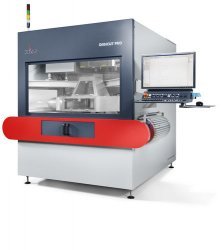
Emerson has launched a new generation of ultrasonic welders that supports the growing demand for assembling plastic components that are increasingly both smaller and more complex. Branson's GSX ultrasonic welding platform is an advanced, flexible assembly solution designed to optimize and ensure quality welds while helping manufacturers meet deadlines and deliver the expected return on investment.
In the medical, electronics and automotive industries, plastic components are increasingly miniaturized, include embedded electronics, and feature complex designs and very thin plastic walls. Conventional welders with high trigger or crushing forces cannot safely weld small, fragile parts. To meet this challenge, Emerson has developed an advanced electromechanical actuation system that delivers unmatched control and position accuracy. This system draws on Branson's more than 70 years of experience in ultrasonic applications, and combines a servo mechanism, software optimization and exclusive dynamic tracking to allow a wide range of trigger forces to be applied, including the lowest in the industry, ensuring welding precision and control. The advanced actuation system also enables the GSX to improve position accuracy, thereby achieving faster, high-performance welds of fragile and complex components.
The highly configurable GSX welding platform allows customers to adapt to many types of applications and parts, using a whole range of welding parameters and actuation modes within a single weld. This ensures improved, consistent, quality welds, thereby reducing rejects. Thanks to a multi-core processor and a drive using a linear encoder, the advanced multi-level actuation system can be adjusted instantly based on real-time measurement feedback. This ensures the same level of precision and repeatability across different welders.
The modular GSX platform is the foundation for a wide range of models to be launched over the next two years, designed to meet the needs of customers' specific applications. The platform can be configured for all production environments, from stand-alone benchtop systems to semi- and fully automated manufacturing lines. Thanks to its strong capacity for integration into a digital environment and the standardized transfer of important data, the GSX platform is compatible with ?Industry 4.0/IIoT?, providing access to actionable diagnostic and performance data, ensuring improvements in production efficiency, traceability and maintenance.
Increasingly demanding production schedules, which must be met to ensure the project's expected return on investment, can be disrupted by a lack of operator experience and expertise. Bridging these potential skills gaps, the GSX platform features simple, intuitive software, supported by touchscreen HMI displays 4? and 12?, which allow operators to set up correct configurations more quickly and reduce application test time. This results in a reduction in start-up time of up to 60 % in most applications, with guaranteed weld quality and increased production efficiency. By storing alignment information and configuration in the assembly parameters, a stack (acoustic assembly) and GSX tooling can be replaced in less than five minutes, whereas conventional ultrasonic welders may require more than 1 hour. The ability to perform faster changeovers makes it possible to weld many components with limited disruption to production schedules.
"To remain competitive, manufacturers must bring their products to market faster in order to maximize profitability," said William Vaughan, Vice President Global Marketing, Assembly Technologies, Emerson. "Branson's GSX delivers six sigma quality levels, enables repeatability, traceability and increased production yield, in order to ensure the expected return on investment of a production line."