












Editorial team · Robotics, Automation, Industrial IT
 InfoWeb Marketplace · Editorial team
Published on 24 August 2012 · 4 min read
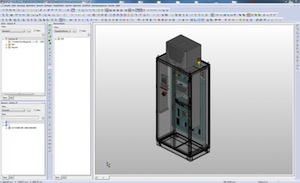
Eplan platform increases process speed at W. Althaus AG by 30%
InfoWeb Marketplace · Editorial teamPublished on 24 August 2012 · 4 min read
Swiss company W. Althaus AG, a full-service provider of industrial automation that sells around 5000 electrical cabinets a year worldwide, uses the Eplan platform as the backbone of its internal data consistency.
The recent migration to Eplan Pro Panel, the 3D system for building switchgear, has brought a significant qualitative leap in process optimization.
Every year, the industrial automation specialists at W. Althaus AG in Switzerland deliver some 5000 electrical cabinets worldwide, from individual and series control units to prototypes, as well as around 800 small control units. Fully automated float glass production in South Korea, which requires availability 24 hours a day, 24, is part of the customer portfolio, as are solar systems and conveyors in the food industry.
The family-owned company, which has around 110 employees, provides a full range of services, from project planning to delivery, commissioning and final acceptance, including hardware and software development. Electrical cabinets, terminal blocks, and operating and control panels are all manufactured in-house, in a production area of more than 6000 m². Cable and wire production is also handled on site. Althaus designers carry out all of their electrical engineering tasks using Eplan Electric P8 and Eplan Pro Panel, the 3D system for building switchgear.
Integration process including 3D data
?We impose no requirements on our customers regarding the parts and components used or the integration of the devices' control units,? explains Marco Schneider, Managing Director of W. Althaus AG. However, this requires rigorous maintenance of complex product databases, which is easy to achieve with Eplan.
The device data of most manufacturers can be imported directly into 3D and synchronization with customer databases is performed even more efficiently thanks to an in-house programmed solution.
With ATHAS, the ?Althaus flexible handling system?, the company has developed a universal, manufacturer-independent solution for the automatic production of terminal blocks using robots, based on Eplan Pro Panel. This solution is now offered to terminal suppliers and other electrical cabinet manufacturers.
?We are committed to achieving the highest possible level of automation,? says Marco Schneider. For him, the Eplan platform is therefore not only engineering and electrical CAD software; it is also the backbone of data consistency within the company.
Projects that have already been completed can be taken over into the databases and reused. Predefined modules, components and sub-projects, including hardware and elements, can be stored in the Eplan database as macros and transferred to ongoing projects. The ERP system is also linked to Eplan; thanks to the automatic generation and adjustment of bills of materials, items that are no longer available in stock can be ordered in good time and according to specific needs.
Eplan Pro Panel: the new dimension
The migration from Eplan Cabinet to the new Eplan Pro Panel - W. Althaus AG is among the very first Swiss companies to have made this transfer - has brought a significant qualitative leap in process optimization. With Eplan Pro Panel, the company consistently uses the 3D data across the entire Eplan platform. For Roland Ackermann, Head of Electrical Engineering, the benefits are obvious; the platform is now perfectly integrated, eliminating the intermediate steps previously required for data transfers saves time and avoids errors, performance has improved significantly and operations are easier, even for beginners.
The quality of simulations has improved thanks to the 3D graphics, you immediately see where each element needs to go and collision points can be avoided from the outset,? explains Roland Ackermann. Above all, he and his team gain flexibility. ?Since all project disciplines are networked on a single database and changes and updates are constantly recorded in the bills of materials, I can also start with the mounting layout based on devices and transfer the circuit diagram and connection definition information later, almost as in Windows, by drag and drop.?
Consistency right through to the production phase
Marco Schneider, the Chief Operating Officer, particularly appreciates the communication strengths of the Eplan solutions. In metalworking, for example for flat mounting plates, Althaus uses a fast laser cutting machine fitted with a tapping head as an unusual extra, as well as a 4-axis machining center for producing plates, enclosures and housings.
The required machining data is generated in Eplan Pro Panel and read directly by the machine's control unit. It is not only the electrical diagrams, bills of materials, terminal block plans or layout plans that have to be generated with Eplan: the same applies to machining data for the systems that cut ducts and rails to length, the wiring assistant and the previously mentioned automatic terminal block assembly machines.
The automated cable production system receives the necessary information on wire lengths, bundle groupings and labeling directly from Eplan, based on the circuit diagram and the 3D cable routing data, and uses it to create ready-to-install, clearly identified harnesses. ?When our production employees start the layout, everything is there and pre-equipped; they essentially assemble a ?construction kit’ and do not spend their time looking for materials and their assignment in the mounting plans,? sums up Marco Schneider.
This option is profitable even for small quantities; it speeds up cycle times and eliminates any source of error, explains the Chief Operating Officer. It is also possible to avoid long and costly corrections and to deploy staff with greater flexibility.
This high level of preparation means that repetitive and routine tasks can be carried out by non-specialists. At Althaus, staff work in teams and handle layouts, quality control and wiring; tests are carried out manually and automatically using the in-house developed ?Panel Scout?.
Process speed 30% higher
According to Marco Schneider, the standardization and automation of processes, which must be as extensive as possible, have, thanks to the Eplan platform, shortened the company's production cycle times by about one third.
Advertisement