












ESI Group's PAM-Composites 2017 Makes Composite Manufacturing Easier
 InfoWeb Marketplace · Editorial team
Published on 19 October 2017 · 2 min read
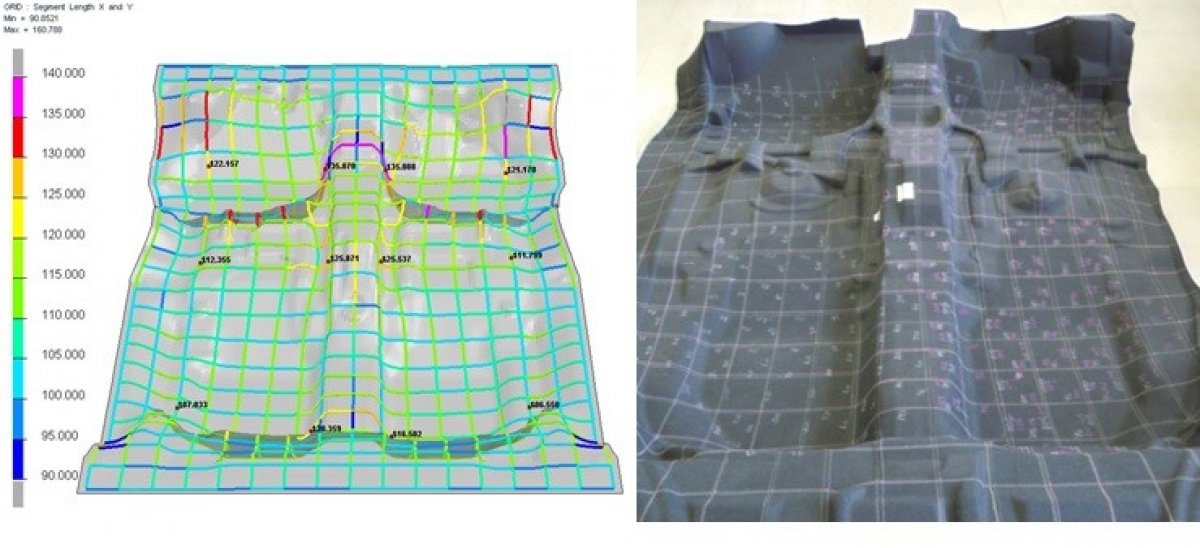
ESI Group, a provider of Virtual Prototyping software and services for manufacturing industries, announces the release of ESI PAM-Composites 2017. This composite manufacturing process simulation solution targets in particular fiber-reinforced structural and semi-structural applications. It also enables the analysis of the manufacturing of multi-material thermoformed interior components with acoustic and cosmetic functions, such as trim parts for vehicles and aircraft.
Manufacturing engineers and design engineers, in both the automotive and aerospace industries, must create lightweight, strong and durable composite components that meet all quality requirements, while working under cost constraints. With PAM-Composites 2017, users can virtually manufacture a part, taking into account the exact physics of the composite material. They can also improve process stability and reduce manufacturing defects, for a wide range of composites and manufacturing processes.
While previous improvements focused on continuous fiber-reinforced composite parts with high expectations in terms of structural performance, version 2017 goes even further. It targets multi-material thermoformed components with acoustic and cosmetic functions, generally used in automotive and aerospace interiors. PAM-Composites now allows users to accurately determine the acoustic and vibration response (NVH, or Noise, Vibration & Harshness) of the manufactured product. At the same time, the software helps predict stiffness and thickness at every location of the stamped part. Typical defects, such as tearing or changes in texture and skin grain induced during manufacturing, can also be anticipated and corrected through simulation. This cost-effective solution enables manufacturing and design engineers to assess the manufacturing of composite parts even more precisely, and thus to reduce lengthy and costly physical trials.
Following changes in automotive regulations, the materials used for car interiors have begun to evolve. One example is the Japanese floor mat manufacturer Kotobukiya Fronte, which had to move quickly from manufacturing elastomer mats to new mats made of synthetic materials: a challenge it tackled swiftly thanks to PAM-Composites.
Takumi Fujino, of the Acoustics & Simulation Group in the R&D Department at Kotobukiya Fronte Co., Ltd, states: ?ESI PAM-Composites is equipped with the functions and parameters needed for mat analysis. The accuracy of this analysis and the ease of use are excellent. The graphical display of results is also easy to understand. That is why we evaluate the tool positively. We regularly consult ESI on various issues such as reducing computation time or the type of modeling required. ESI frequently provides us with proactive information. We recognize that the first practical application of simulating a sound-absorbing type of mat is largely due to the support of ESI's Japanese subsidiary.?
Among the new features of PAM-Composites 2017, the solution now includes a grid tracing tool that allows engineers to analyze the length variation on each segment of the grid as they would on physical prototypes. In addition, the new automatic element deletion feature makes it possible to visualize physical holes or fiber separations generated during the thermoforming of composite parts. PAM-Composites 2017 supports automotive and aerospace designers and engineers who, thanks to a user-oriented graphical interface, no longer need to be finite element experts.