












Editorial team · Power transmission, Mechanical components
 InfoWeb Marketplace · Editorial team
Published on 26 July 2012 · 2 min read
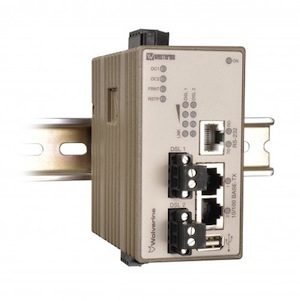
Ethernet extender for high-speed network connections over existing cabling
InfoWeb Marketplace · Editorial teamPublished on 26 July 2012 · 2 min read
A compact, easy-to-use device for railway and industrial applications and power distribution networks.
Westermo has expanded its Ethernet extender series with the launch of a compact high-speed model capable of meeting the growing demand for data transfer in industrial applications. The DDW-142 is the latest addition to the Wolverine range, which uses SHDSL technology to establish a high-speed connection between Ethernet networks over existing copper cables. This can generate considerable savings when installing new systems where, in the past, fibre would have been the only option.
The DDW-142 is a fully managed device with 2 switch functionality that makes it possible to build efficient Ethernet networks over distances of up to 15 km. Speeds of up to 30.4 Mbit/s are possible, making the device suitable for linking complex networks that may include a large number of devices requiring high bandwidth. An integrated 100 Mbit 2-port switch makes it possible to link two Ethernet devices, and an RS-232 port allows existing devices to be easily incorporated into the IP network.
To make life easier for engineers who install and maintain increasingly complex networks, the DDW-142 has been designed to be extremely easy to install, requiring no configuration for simple point-to-point communications. For larger networks, a web interface is provided and a CLI allows more complex configuration.
The Wolverine range is also equipped with a unique cable distance calculator. It uses real application data to enable installers to calculate the achievable speed and distances using different types of cable. Once installed, the SHDSL diagnostic and management functions can indicate line degradation, allowing scheduled maintenance. If maintenance work is needed, a backup and restore service makes it possible to quickly download configurations using a USB stick.
The DDW-142 is designed for harsh environments, such as railway, road and power distribution applications where a failure could result in significant costs. The very compact and robust unit can operate at extreme temperatures (-40 to +70°C) and where EMC and vibration levels are high. Full galvanic isolation and transient protection of the electronic components deliver a mean time between failures of 437 000 hours, ensuring high operational reliability and a long service life.
The Wolverine WeOS operating system offers an extensive suite of IP network management standards for creating resilient and flexible networks. Developed to enable durable multi-platform solutions, WeOS provides a unique level of security and allows the DDW-142 to be part of a resilient multi-point, point-to-point ring network. In the event of a hardware or link failure, Westermo's unique FRNT technology is able to reconfigure a large network.
The DDW-142 is transparent to multicast addressing, allows VPN (virtual private network) pass-through for IPSec (Internet Protocol Security) and can be used with protocols such as Modbus/TCP and PROFINET I/O. The DDW-142 also offers a Link Fault Forward (LFF) function whereby the status of the Ethernet link is sent over the SHDSL link between two units.
