












Faulhaber Group's intelligent robots take care of the shelving
 InfoWeb Marketplace · Editorial team
Published on 29 May 2018 · 5 min read
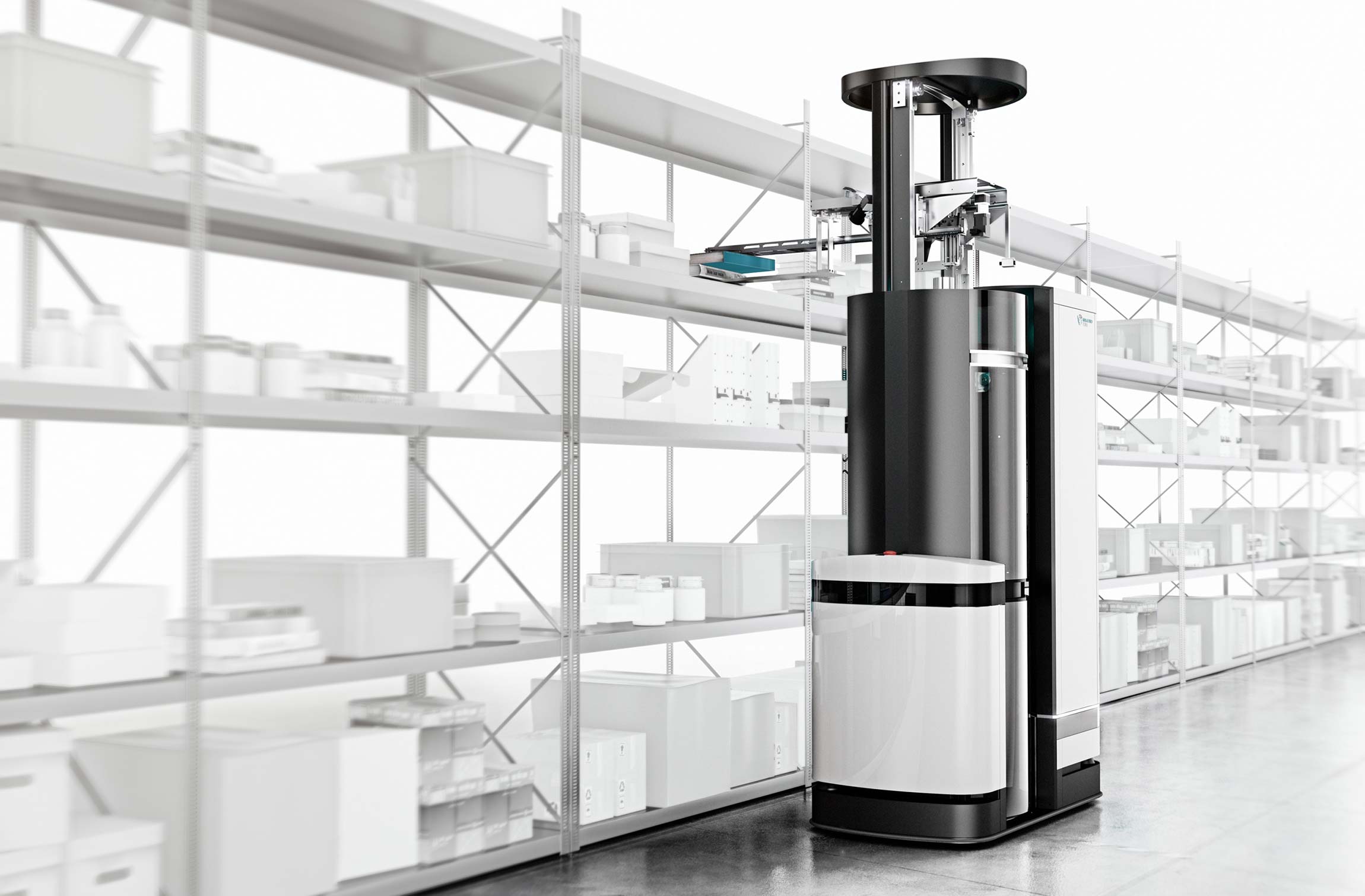
The versatility of Magazino's TORU picking robot is thanks to FAULHABER micro-drives and motion controllers.
Against the backdrop of the continuous growth of online retail, logistics and material flow are highly sought-after fields for experimenting with technical progress, with the aim of increasing efficiency through automation and digitalization. Magazino, a young company from Munich (Germany), has set out to intelligently combine autonomous navigation and robotics. The solution is called TORU and has what it takes to revolutionize the world of logistics. For the handling operations of the autonomously navigating logistics robot, Magazino uses FAULHABER drive solutions with integrated motion controller.
Their vision is clearly formulated: Magazino wants to create the world's first warehouse that thinks and acts autonomously - and they are well on their way to achieving it. The new logistics robot is called TORU and is currently proving itself in practical tests at leading shipping service providers. These companies mainly use the intelligent, autonomously navigating system to fetch shoe boxes during order picking. TORU is designed as a perception-controlled robot. Thanks to the use of cameras, image processing, sensors and artificial intelligence, it is able to correctly perceive and interpret its environment, and then use it to make decisions.
The robot creates its own picture of its environment
Making decisions? When TORU receives the order to pick a certain pair of shoes, it first obtains the address in the warehouse and a barcode. The robot thus knows the location of the target and can navigate directly to the address. The lifting column located at the front of the vehicle then rotates by 90° towards the shelf, a gripper moves to the specified location, and this is when TORU starts making decisions by itself. Using three-dimensional camera images, the robot first produces a picture of the current situation. ?Does the shelf contain even a single shoe box? Is the appropriate barcode present? Am I able to grasp the box? Might it have been shifted by a few centimeters and risk getting stuck during extraction?? Magazino spokesperson Florin Wahl uses these questions to describe the main tasks of visual analysis. The corresponding answers make the Munich system unique. If a picking order concerns a box that an employee has placed slightly crooked on the shelf, the robot tries to adapt its gripping process to the circumstances. If TORU determines that gripping is still not possible, the task is returned to the system and a warehouse employee will have to carry out this picking order manually.
If no problem is detected, the task of handling the shoe boxes falls mainly to the FAULHABER drives. Motion controllers, graphite-commutated DC micromotors of type 3242, planetary gearheads and threaded screws form a linear drive system used to extend or retract a metal tab. In this case, the task is to bridge the gap between the vehicle and the bottom of the shelf. The path is thus leveled to allow the boxes to be extracted over a flat surface, using negative pressure.
Powerful overload behavior
To position the suction gripper along a rack, Magazino uses FAULHABER drives of type 3268. With a power of 62 watts, the brushless DC motors deliver rated torques of up to 72 mNm in continuous operation. Peak torques of up to 96 mNm prove of interest to Magazino. Overload capacity is decisive for overcoming breakaway torques when handling the shoe boxes. ?We need motors with a high power density,? explains Raphael Vering of the development and engineering department at Magazino. Since peak torques are only required for a very short time, there is no risk of the motors overheating.
Smaller drives
The strong overload behavior of the motors (with a diameter of only 32 mm) offers a number of advantages to the Munich logistics pioneers. The design makes it possible to use smaller motors thanks to the reliable handling of breakaway torques. Consequently, smaller drives are naturally lighter. ?The mass of the gripper must be as low as possible because, of course, TORU also has to be able to move along the vertical axis,? says Raphael Vering. The heavier the gripping unit, the higher the motor power of the vertical axis must be. In addition, there is the question of the center of mass when TORU has to grasp a shoe box located on the top level of a two-meter rack.
Of course, the center of mass can easily be shifted downwards using a thicker support plate. However, this makes the travel unit heavier and requires a more powerful drive motor and, consequently, higher battery power, which reduces range. TORU also requires a lightweight design since it is intended for use not only on solid floors, but also on more fragile intermediate structures. ?Surface loads are particularly limited here, but we want TORU to be as versatile as possible,? adds Florin Wahl. Larger motors would restrict handling, especially when boxes are stored only a few centimeters above the floor, and the drives must not get in the way. Thanks to the FAULHABER solution, Magazino is able to move very slowly downwards and then upwards again. ?This is extremely important when considering the capacity of a warehouse relative to its floor space. Every additional bit of shelf space is worth its weight in gold,? sums up Florin Wahl.
The idea behind TORU is to set up a sophisticated system combining automation, robotics, vision and autonomous navigation. When evaluating drives, Magazino therefore looked for solutions offering optimal power density. However, these must also be able to be integrated elegantly into the existing automation concept. ?Support for CANopen communication was a decisive criterion for us,? recalls Raphael Vering.
As the Munich company was also able to use a complete and perfectly suited motion control system from FAULHABER, the development department gained greater freedom for future optimizations of the new logistics solution. ?We don't need to spend time on our own controllers or on encoder integration,? stresses Mr. Vering. Combined with DC micromotors, the FAULHABER motion controllers of the V2.5 generation form highly dynamic positioning systems. For feedback control, Magazino uses analog Hall sensors, which makes a separate encoder for feedback unnecessary. The integrated current control of the motion controllers limits the torque and thus protects the electronics and the motor from overload.
