












Horn: expertise in coating precision tools
 InfoWeb Marketplace · Editorial team
Published on 20 February 2020 · 3 min read
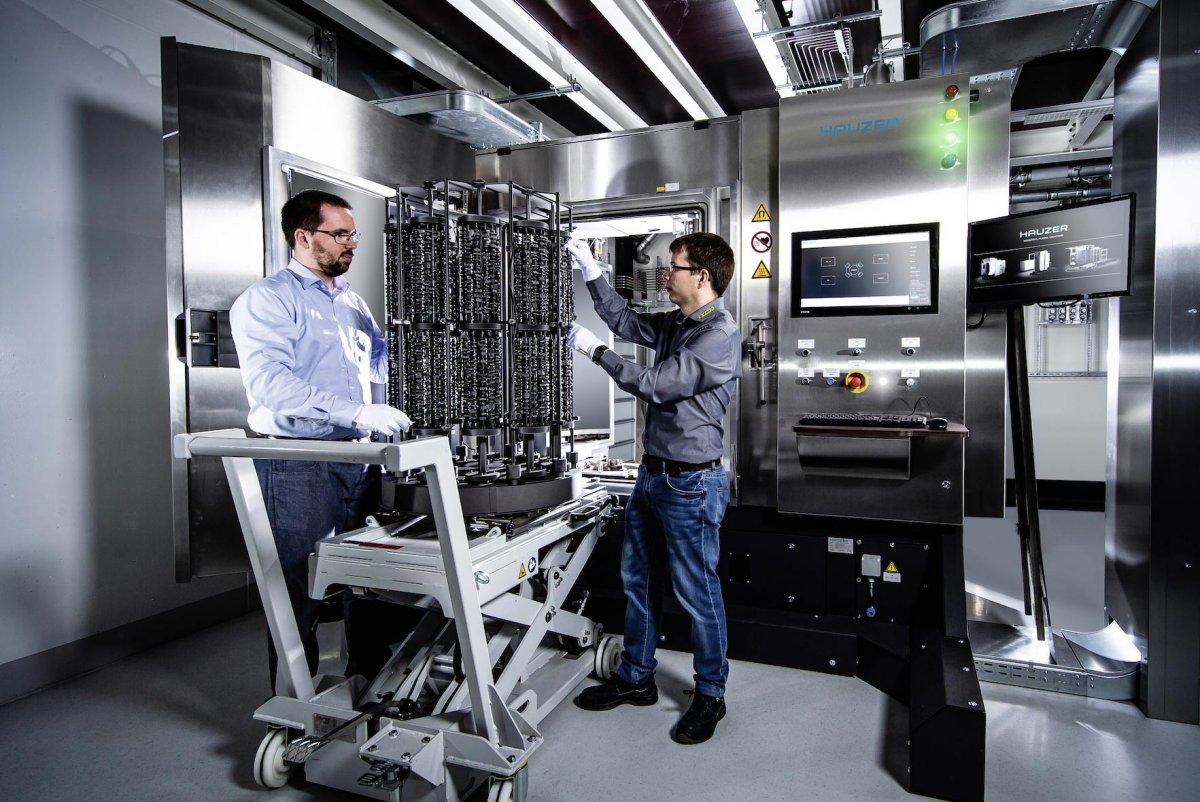
Every day, we come into contact with coatings. Paint, electroplating or other coating techniques. On cars, they are a matter of passion or identification; in technical applications, they are synonymous with increased performance and longer service life.
Over the past 15 years, the German cutting tool manufacturer HORN has built up considerable expertise in coating precision tools. Starting with five employees and a single coating system, more than 50 people now work on the twelve systems and in the corresponding peripheral areas of the coating department. In addition, engineers are constantly researching and developing new layers or improving existing ones, always with the aim of making coatings on tools more efficient. A layer only a few microns thick can indeed increase the service life of carbide cutting inserts by up to 1000 %, or even more.
A coating is the adaptation of the surface properties of a part
A layer a few thousandths of a millimeter thick influences tool wear, with everything that this implies for the machine, energy consumption, production resources and auxiliary materials. To adapt this layer to the application and to the diversity of HORN tools, the company is constantly investing in coating processes such as PVD sputtering technology and the new HiPIMS coating technology (High Power Impulse Magnetron Sputtering). The HiPIMS process produces a more homogeneous and much more durable layer, whose hardness and resistance are convincing, particularly in steel machining by chip removal and in the machining of small and very small parts. This technology has made it possible, for the first time, to cover various grooving and milling tools with the new EG3 and EG5 coatings developed by HORN.
The new Horn EG3 and EG5 coatings
The EG3 and EG5 coatings consist of titanium aluminum nitride (TiAIN). EG3 is used mainly on Supermini turning tools (bore diameter greater than or equal to 0,2 mm) and on ground indexable cutting inserts. Both types of tools can be perfectly covered with the EG3 coating thanks to their smooth, well-adhering surface. The EG5 layer is preferably used with indexable cutting inserts for circular milling with contour radii from 0,01 to 0,03 mm.
With different layer thicknesses, the two coatings have a very dense structure, with a particularly smooth layer while offering better adhesion. The ratio between layer adhesion and internal stress is thus very well balanced and ensures the high hardness of the cutting edge. A final golden top layer makes wear easier to detect.
The company TecVo tested EG3: the coating increases the productivity of grooving
The German company TecVo specializes in turning, with workpiece diameters of up to 380 mm. It focuses on supplying parts for the hydraulics industry, industrial valves and fittings, and the construction sector, for rail vehicles and mechanical engineering. The company faces new challenges as it has to produce more and more turned parts with grooves of all kinds. One example: machining various grooves with a mean roughness depth Rz of less than or equal to 6,3 microns in three geometrically similar parts. For call-off orders in batches of 50 to 200 parts, the task was to find a viable solution for machining the parts with a suitable process, and above all while meeting the lead time and the cost per part.
Various tests were carried out in collaboration with the HORN technical advisor. In the end, the insert holder type 213, usable for all three parts and developed for grooving and longitudinal turning, was used as the tool holder. A two-edged indexable Cermet cutting insert of type S229, with a EG3 coating and the universal .20. geometry, proved to be the best. The tests with the EG3 coating were convincing. Objective achieved: process-compliant Rz values and a longer service life.
