












igus motion plastics enter new industrial sectors
 InfoWeb Marketplace · Editorial team
Published on 23 April 2019 · 4 min read
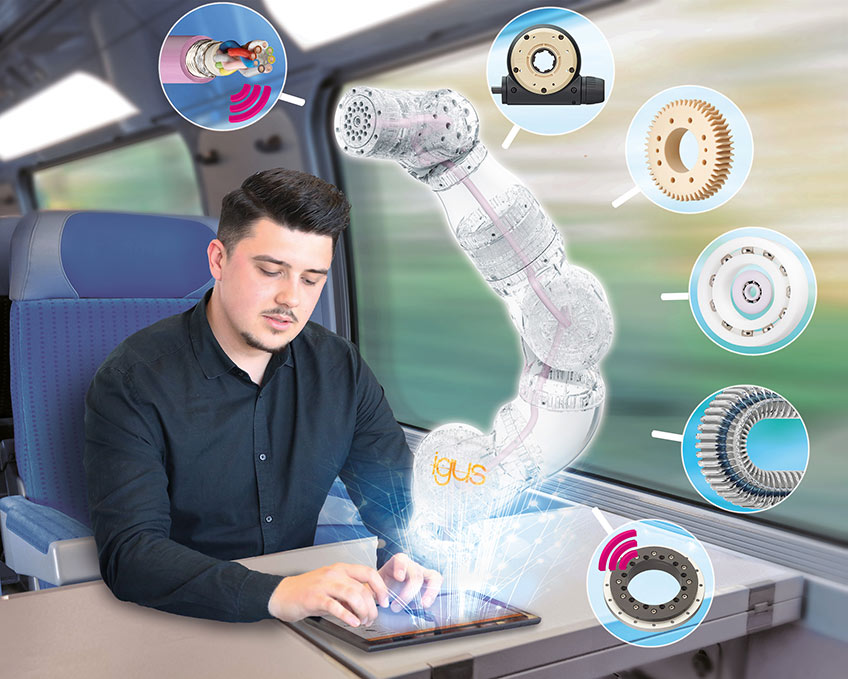
igus motion plastics can be configured online on a tablet from anywhere, printed as long-life special parts, or equipped with intelligent elements. Motion plastics are undergoing a true revolution and are increasingly regarded as high-tech components. igus reflects this transformation with 120 new products at the upcoming Hannover Fair, from the smart plain bearing to the world's first online platform where suppliers and users of low-cost robotics meet.
Motion plastics are at the heart of igus's expertise and are entering new sectors of the industrial world every year, whether it is 3D printing of wear parts with an online-calculable service life, "smart plastics", energy chains for travels of 1.000 meters, or polymer ball bearings with a tenfold service life. This is a successful strategy, as high-performance polymers designed for motion continue to be in strong demand worldwide. It enabled the igus group to record in 2018 a 8,5% increase in sales, which rose to 748 million euros worldwide. In France, sales exceeded 22 million euros, which corresponds to growth of 9% compared with the previous year. 53% of this turnover was generated in Europe, 31% in Asia and 16% in America and Africa. The workforce has grown to 4.150 people, including a good sixty in France.
A start-up spirit to conquer new sectors
igus is growing purely organically and is constantly conquering new markets, such as stage and theater technology or the solar sector. A start-up enthusiasm prevails at the main site in Cologne, Germany. "Agile working methods and open structures allow us to quickly implement new ideas related to motion plastics in sprint teams," says Frank Blase, Chief Executive Officer of the igus group. "We try, we redo, we improve, until we can provide users with the exact product that will help them move forward." This momentum has given rise to the 120 new products presented this year at the Hannover Fair. These new products clearly prove that plastic machine components have long been considered high-tech. igus takes advantage of the possibilities offered by digitalization and presents plain bearings that can be made intelligent. With the icom.plus communication module, customers can choose how they wish to connect the data supplied by the sensors. They can integrate and extract their data as they wish, from an offline version for restrictive environments to a data connection to the igus server for automatic ordering of spare parts.
New horizons for users with the robotics platform and 3D printing
igus high-performance polymers also increase the possibilities offered by low-cost automation. Indeed, producing robots with gearboxes and many other plastic parts considerably reduces costs, and makes it possible to offer robots from 3.000 euros. In cooperation with 16 partners from the industrial world, igus is presenting, as a world premiere, the online platform rbtx.com, which offers a forum for suppliers and users of "lean" robotics. On this platform, customers can fully configure industrial and service robots. Growth was also strong at igus in additive manufacturing last year. 3D printing capacities were tripled through the purchase of new FSL printers, and a new high-temperature printer was developed for the iglidur J350 tribo-filament, which is resistant to high temperatures. For common machine elements such as gears and rollers, igus now offers special online configurators and printed solutions with excellent wear behavior. And, unique in the world, the service life of these printed components can be calculated online.
The test laboratory, a driver of growth
These calculations are based on data from the test laboratory. Last year, more than 264 new polymer composites were developed and tested in the laboratory. In this context, more than 11.300 tests were carried out for plain bearings alone on more than 50 different test rigs. In the laboratory dedicated to energy chains and cables, more than 4.100 tests were carried out in 2018, representing more than 10 billion energy chain cycles. The test laboratory is also an ideas laboratory where special solutions based on tribo-polymers are developed for a wide variety of fields and applications.
One of these developments is the iglidur Q2E plain bearing, which is capable of ensuring safe, completely grease-free guidance of loads of up to 30 tons on a bearing with a diameter of 20 mm, in construction machinery and agriculture, for example. The E4Q energy chain, for its part, is designed for long travels. With its fine roller-shaped structure, it saves weight and is fitted with openable crossbars for easy assembly without tools. To test these long travels in particular, a new test facility is under construction outdoors. The area of the test laboratory will thus grow to more than 3.800 square meters.
Capacities are also increasing outside Germany, so that products can be supplied quickly to customers around the world. 5.000 square meters have been added to the US subsidiary, which now has some 19.000 square meters of offices and production space. A project for a new 22.000 square meter unit is under construction in China, and its completion is planned for August. Expansions are also under way in Brazil, India, Poland and Thailand, while a plot of land has just been purchased in South Korea for the new construction of the subsidiary. The building, with an area of 9.500 square meters, will be completed by the end of 2019.
