












Integration of Eplan Electric P8 with Melsoft iQ Works via AutomationML
 InfoWeb Marketplace · Editorial team
Published on 4 April 2018 · 2 min read
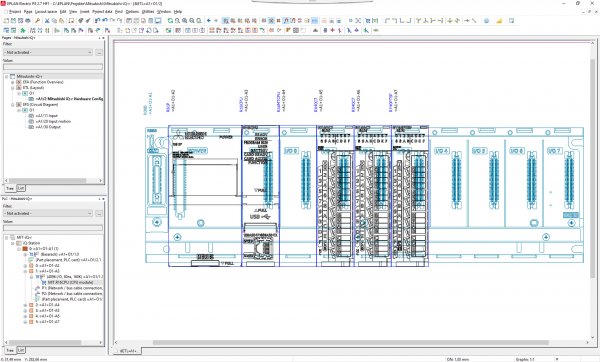
Thanks to AutomationML, the new solution integrating Eplan Electric P8 with Mitsubishi Electric's Melsoft iQ Works connects electrical engineering and automation. Data such as symbolic addresses can now be exchanged with the current software suite through a bidirectional process. In Eplan Electric P8, the results are impressive: valid diagrams, notably for the bus wiring between PLC components, and state-of-the-art hardware configurations.
The bidirectional exchange of PLC data optimizes processes in both engineering and automation. With this new integration between Eplan Electric P8 and Melsoft iQ Works, the solution provider Eplan and Mitsubishi Electric have taken this capability further. AutomationML provides the integration framework. The data set created in Eplan forms the basis for the hardware assembly (rack) and the software programming of the PLC. A key point: the data is passed on throughout the product development process as a single source of truth (SSOT). Eplan's Data Portal provides the required component data. Combined, these solutions speed up component configuration and drawing planning.
Melsoft iQ Works is an integrated software suite that includes the software solutions required to program Mitsubishi Electric's automation products. The new integration with the current Eplan platform (version 2.7) allows users to exchange, then modify and synchronize data in all directions, at any stage of the project. Data now only has to be entered once, which reduces input errors. This capability also simplifies cooperation between electrical engineers and software developers. Users in electrical design also benefit from further advantages: the allocation of PLC assemblies is considerably simplified. Modifying assemblies with system support is faster, and last-minute changes can be made more easily and implemented universally.
AutomationML technology
Using a standardized, non-proprietary XML data format, AutomationML can represent design information according to system topologies, structures, geometries and logic. To display structural and topological information, AutomationML uses CAEX (Computer Aided Engineering Exchange), an international data format compliant with IEC standards 62424 and 62714. Incorporating essentially object-oriented concepts, it makes it possible to represent plant and system structures. AutomationML also offers the possibility of transmitting system structures, such as rack assemblies. This makes it possible to produce optimized end-to-end documentation, even for maintenance operations. Data from the various software tools, such as device-related information, can be exchanged between manufacturers and users and easily integrated into the documentation.