












Editorial team · Materials, Tools, Components
 InfoWeb Marketplace · Editorial team
Published on 26 August 2013 · 4 min read
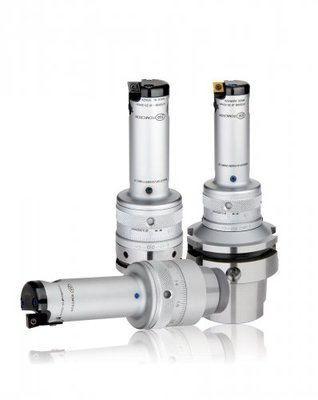
Kennametal Romicron® Precision Boring
InfoWeb Marketplace · Editorial teamPublished on 26 August 2013 · 4 min read
Precise bores achieved with the newly optimized Kennametal Romicron® precision boring system
Produce high-precision holes at high speed without any additional adjustment equipment and without requiring any precision boring skills from the operator.
Kennametal Romicron® precision boring systems allow users to achieve tight tolerances while leaving the tool in the machine, saving time without any specific training. They can produce finish bores with diameter tolerances of just a few microns (1 micron = 0.001 mm).
Machining precision is growing strongly in many manufacturing sectors, in particular aerospace, energy, transportation and medical. In the past, this meant using complex tools specific to high-precision boring, sometimes requiring costly installations, a wide range of tools, comprehensive personnel training and tedious cutting trials.
The recently improved Romicron® boring tools from the Kennametal range can be used on all existing machine tools and produce fine bores in production within diameter tolerances of a few microns (1 micron = 0,001 mm). Using cartridges or boring bars, all Romicron® tools are adjustable in diameter by means of a graduated ring with 2 micron increments in order to obtain very tight tolerances.
The Romicron tool is equipped with a vernier click mechanism that offers instant adjustment without backlash: machine operators can thus hear it, feel it and see it as a direct reading on the vernier.
The new Romicron® AVS covers a diameter range from 25 to 79 mm and can be used with high-speed spindles up to 20 000 tr/min. It is fitted with standard ISO inserts, including the latest inserts from the Kennametal BeyondTM range, and can work with high-pressure coolant systems up to 120 bar for better chip evacuation and to reduce the temperature at the cutting edge.
The Romicron® system essentially consists of a patented mechanism with a sliding wedge that works like a transmission, converting the adjustment at a ratio of approximately 10:1. In other words, the adjustment made by the operator on the tool is converted into a very fine adjustment of the cutting diameter. The sliding wedge mechanism is self-locking, so no locking screw is needed.
The backlash-free adjustment mechanism makes it possible to increase or decrease the diameter precisely, controlled by the number of increments, unlike the many back-and-forth movements of backlash-compensation systems. Since adjustments with the Romicron system are easy to make and require no additional measuring or inspection equipment, adjustment can be done directly on the machine spindle.
The time savings are remarkable: a few ?clicks? take a matter of seconds, whereas with other systems adjustment can take up to several minutes.
Furthermore, since the Romicron system requires neither locking screws nor additional equipment, the setting and adjustment process can be automated by the machine's numerical control, and therefore without any human intervention. The machine, equipped with measuring instruments, measures the hole, processes the data and itself controls the incrementing of the tool.
To do this, the CNC calculates the number of increments needed to adjust the tool and stay within the bore's tolerance limits. To carry out the operation, the machine brings the Romicron tool to a given position. A spring-loaded retractable locking pin positioned in the machine engages in the various holes of the tool and repeats the operation until the final setting is reached. The tool then continues machining until the next scheduled measuring or programmed adjustment cycle.
Tips for precision bore finishing
Romicron boring systems can produce fine bores with diameter tolerances of a few microns if the following guidelines are observed:
- The finishing stock must be distributed concentrically and evenly, within limits less than or equal to 0,25 mm.
- The feed must be less than or equal to 0,15 mm per revolution, depending on the material to be machined and the surface finish tolerances to be achieved.
- The nose radius of the tool tip must be checked before machining begins.
- Under normal conditions, tolerances corresponding to ISO precision class IT6 can be obtained. For large diameters, class IT5 can also be achieved.
- Proper positioning and holding of the workpiece is essential. Thin-walled parts, for example, tend to deform and must therefore be clamped correctly.
- Specific extensions may be necessary for bore depths greater than 2,5 x D.
- For machining exotic materials, a careful examination must be carried out beforehand.
Kennametal
A leader in industrial technology celebrating seventy-five years in business, Kennametal Inc. delivers productivity to customers seeking peak performance in demanding environments.
The company provides innovative wear-resistant products, application engineering and services backed by the latest advances in materials science. It serves customers in 60 countries across sectors such as aerospace, earthmoving, energy, general engineering, transportation and infrastructure.
With approximately 13 000 employees and sales of nearly $3 billion, the company generates half of its revenue outside North America and 40% globally from innovations introduced in the past five years.
Recognized among ?the World's Most Ethical Companies? (by the Ethisphere Institute), as a ?remarkably innovative company? (by the PDMA - Product Development Management Association), and as one of ?America's Safest Companies? (by EHS Today magazine) with a 100% focus on safety, Kennametal and its Foundation invest in technical education, industrial technologies and materials science to deliver on the promise of progress and economic prosperity for all.
Advertisement