












Keyence, 1D and 2D Series-2000 code readers for simplified reading
 InfoWeb Marketplace · Editorial team
Published on 31 October 2017 · 3 min read
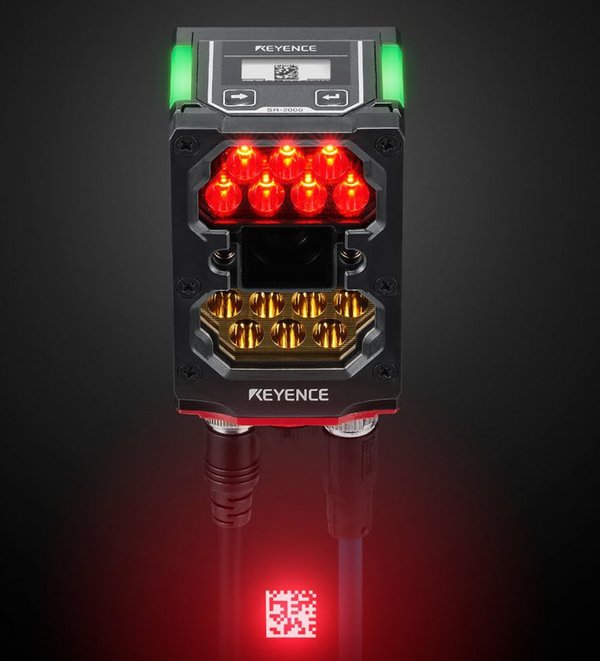
Keyence SR-2000 Series 1D and 2D code readers: a revolution!
A single reader that simultaneously reads several 1D and/or 2D codes, regardless of the distances within the reader's field of view and the line speed… With the launch of the SR-2000 Series, Keyence is revolutionizing the reading of barcodes and 2D codes.
Thanks to an ultra-wide field of view, a large depth of field, and the ability to read several codes simultaneously at different distances from the reader, even while moving, including on a rotating cylinder, the Keyence SR-2000 Series considerably simplifies the use of 1D/2D codes in all industries. It is also extremely simple to install, which makes it accessible to everyone. Several innovations contribute to this new level of performance.
High-performance, low-noise, high-sensitivity CMOS sensor
The CMOS sensor of the SR-2000 Series has 3,1 million pixels. It is the most powerful in its category. It offers a field of view more than twice as wide as conventional models. Its sensitivity, 1,6 times higher than that of conventional models, allows a considerable reduction in noise.
For example, it is possible to capture in a single shot not just 15 but 50 electronic components bearing a 2D code of 0,19 mm. Images can be obtained even with a very short exposure time of around 100 ?s.
CPC (compound parabolic concentrator) lighting system
The field of view of the SR-2000 Series is illuminated by 14 LEDs. For each of these LEDs, the lighting system incorporates a parabolic reflector that reduces light intensity loss (gold plating is used to maximize the reflectance of the reflector). The result is intense, uniform lighting, guaranteed even in a wide field of view and at long distances. As a result, for example, even low-contrast codes can be read reliably.
New optics and new image processing
The Keyence SR-2000 Series combines two key elements to optimize code reading performance.
Its large depth-of-field lens guarantees minimal blur from the foreground to the background without requiring any additional steps or mechanical equipment (focusing by tool change, position controller, etc.).
In addition to eliminating areas that are too bright or too dark, brand-new algorithms (pattern search and corrections) achieve a reading distance 30% greater than that of conventional readers. The detection mode switches automatically between pattern search for barcodes and upscaling (enlargement and correction) for 2D codes.
High-speed triple-core processor
In addition to the care taken in image capture, the Keyence SR-2000 Series benefits from processing by three processors for (1) image capture, (2) filtering, and (3) decoding. A distinctive feature of the SR-2000 Series is that an FPGA processor performs image filtering during image capture. This considerably reduces the total processing time. In addition, the processing speed of the DSP (for decoding) has been increased by 30% compared with that of conventional models.
As a result, despite the high resolution (and the processing of 3,1 million pixels), the image transfer time remains equivalent to that of conventional cameras equipped with a 1,3-megapixel sensor. The ability of the SR-2000 Series to read several codes in a wide field of view at high speed has made it possible to increase the number of images captured while ensuring highly stable reading.
Even better user-friendliness
In addition to its reading performance, the Keyence SR-2000 Series will also be appreciated for its simple setup, fully automatic calibration, and all of its automatic settings.
Complex applications, made simple
The Keyence SR-2000 Series performs detections considered impossible with conventional code readers.
Its unique functions allow the user to do away with many devices and tasks that have become unnecessary.
Its pulse trigger, match level evaluation, code verification and continuous activation functions, among others, as well as the possibility of adding a lighting system, combining several reading heads, editing data, etc., make it a unique solution.
