












Editorial team · Machine tools
 InfoWeb Marketplace · Editorial team
Published on 19 February 2010 · 4 min read
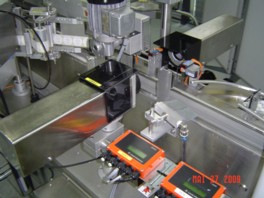
Keyence vision systems speed up and make pharmaceutical product marking more reliable
InfoWeb Marketplace · Editorial teamPublished on 19 February 2010 · 4 min read
At its Evreux plant, GlaxoSmithKline, seeking to improve its manufacturing processes, needed to upgrade the vision system on its high-speed marking lines. The previous system required automatic verification to be deactivated, which forced the plant to have operators carry out the inspection. Not only is the Keyence solution reliable, it is also much cheaper than those of its competitors.
The vision system that checks the marking consists of 3 cameras. "The first is involved in the most delicate phase, because it must read black laser marking on plastic cases of different colors - 4 for four different molecules. While reading is fairly easy on green or orange, it proves complex on blue or purple, which offer limited contrast," explains Sylvain Bouckenooghe, project manager.
The solution was to apply specific lighting: "We went directly to Keyence, who found a solution to our problems. The sales engineer proposed the necessary settings, including for the lighting. Keyence then lent us the equipment, which let us see immediately that it worked perfectly. Since then, one million parts have gone through in 4 months in 3/8, without the slightest failure."
The second camera checks the application of a label, in terms of both concentricity and position, with a tolerance of approximately 0,3 mm, while the last camera reads a label to verify that the expiry date is correctly indicated. For this, the vision system uses an integrated OCR.
Power serving detection reliability
"We knew from the start that the system was more than powerful enough for our production rates. We are, however, very satisfied with the detection stability. In pharmaceuticals it is even more demanding, because we cannot accept 99,99 % reliability, only 100%," adds Sylvain Bouckenooghe.
Keyence's CV-5000 is the most powerful standalone vision system on the market. It offers, for example, the ability to process 1 million pixels in 20,5 ms. This computing power also makes production inspection more reliable: its repeatability is the highest on the market (7x better than current standards), and numerous image processing options are available to optimize inspection accuracy. In addition, 18 inspection functions are offered. They meet the needs of the most demanding vision applications (including Shape Trax modes and OCR).
The models of the CV-5000 series are driven by a high-speed color image processing engine and a high-speed RISC central unit (reduced instruction set computer) combined with two DSPs (digital signal processors) dedicated to image processing. Overall, the models in the series use four processors to achieve parallel processing and the highest possible processing speed. The central unit and the DSPs make it possible to reach twice the speed of the best existing models on the market.
A very economical and high-performance solution
"We launched a call for tenders and were surprised to find that the Keyence offer was three times cheaper," explains Sylvain Bouckenooghe. "The difference is explained by the fact that our cameras are much easier to integrate.
Keyence France includes the service in its price, so even with similar hardware costs, we are much cheaper," explains Alexandre BONY, Vision Product Manager at Keyence France. "Implementation took only 4 days. Project management was relatively simple. Our experience with vision systems allowed us to quickly identify the key points so as not to waste too much time or energy on details," adds Sylvain Bouckenooghe.
The CV-5000 series has functions that make implementation easier. For example, a lighting adjustment automatically restores the brightness of a captured image to that of the pre-recorded reference image. This avoids anomalies caused by lighting degradation and variations in ambient light. In addition, up to 16 types of filters can be defined per window (anti-glare, color processing, etc.).
Finally, the CV-5000 series is a multi-camera system: up to 4 cameras can be connected to the controller from a choice of 12 cameras, the widest choice on the market. This is economically advantageous when the inspection involves several cameras. This configuration also allows large industrial sites to implement highly consistent solutions, which are therefore simpler and more economical to install and maintain. Among these cameras, color CCD models of 2 million pixels or 5 million pixels are available (the highest on the market).
These cameras can process a total of 2 million pixels in a single operation. The 7x high-speed CCD cameras of the CV-5000 series are also offered. They are the fastest in their category and adapt easily to ultra-fast lines and continuous parts production. The 1 million-pixel camera models can perform processing in about the same time as conventional 240 000 pixel models.
An open system
"We prefer to have control over the inspection equipment. We did not want a black box like other systems offered on the market. This is a strong point of the Keyence solution, because we can modify internal parameters or add inspection tools simply, without going through the supplier. This way we avoid extra costs after commissioning," concludes Sylvain Bouckenooghe.
The CV-5000 series offers maximum connectivity: digital I/O, Ethernet port, USB and RS-232... Interfacing with the PLC was immediate. It obviously serves to eject non-conforming products from the production line.
