












Editorial team · Packing, Handling, Logistics
 InfoWeb Marketplace · Editorial team
Published on 15 December 2012 · 3 min read
Largest Coca-Cola Bottler Equips Its Operations with Crown Lift Trucks
InfoWeb Marketplace · Editorial teamPublished on 15 December 2012 · 3 min read
Crown is the ?right choice? for fuel cell technology
The largest independent Coca-Cola bottler in the United States takes delivery of a fleet of Crown lift trucks powered by fuel cells
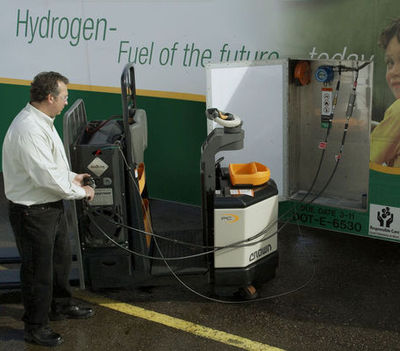
In recent years, fuel cell technology has benefited from huge investment, especially in the United States, and Crown has been researching the use of fuel cells in lift trucks for more than 7 years. In October 2008, the company even established its own research and testing center dedicated entirely to fuel cells. Crown has also launched the industry's first fuel cell qualification program and has to date qualified more than 20 lift truck models capable of running on fuel cells in the US market. Many of these vehicles are already operated by customers at sites in Canada and the United States. A fleet of 35 Crown FC Series 4500 counterbalance trucks equipped with fuel cells has just been delivered to Coca-Cola Bottling Co. Consolidated, further demonstrating the leading position of this lift truck manufacturer in the deployment of fuel cell-powered lift trucks.
Practical innovation paves the way to success
Crown has always believed that technologies should only be brought to market when they are fully mature. It was clear from the outset that lift trucks would only be fitted with fuel cells once they had proven able to match the high levels of performance, efficiency and safety of conventional battery-powered vehicles. Crown therefore created a research and testing center near its US headquarters in Ohio, dedicated exclusively to research into fuel cell technology. Crown is also the first lift truck manufacturer to have set up a fuel cell qualification program, and it works closely with the government institutions that have supported the development of fuel cell technology in the United States through government funding for many years.
This commitment to fuel cell technology research played a role in the choice of Crown products for Coca-Cola Bottling Co. Consolidated. ?We are one of the first Coca-Cola bottlers to adopt lift trucks with fuel cells. So we had the heavy responsibility of choosing a supplier that had carried out extensive research into this technology and was strongly committed to its customers' sustainability initiatives as well as its own,? explains Dave Brown, Vice President of Manufacturing at Coca-Cola Bottling Co. Consolidated. ?After visiting Crown's fuel cell research center and its manufacturing areas, we knew we had made the right choice.? For several years, Crown has been studying the performance and durability issues associated with the use of fuel cells in lift trucks, working closely with leading fuel cell manufacturers to optimize both aspects. Exhaustive testing has provided valuable data on the adaptations to be made to the trucks so that they can be fitted with the new technology, and customers can now be confident that their fuel cell lift trucks will meet the same strict standards as conventional electric trucks. This also applies to the fleet of FC Series 4500 counterbalance trucks with fuel cells that has just been delivered to Coca-Cola Bottling Co. Consolidated.
Better efficiency, better sustainability
Adapting a fleet of lift trucks to fuel cell technology requires investment in additional infrastructure, for example for hydrogen storage. But this initial investment is generally offset by the benefits of the new technology, such as a potential increase in productivity. Indeed, fuel cells can supply lift trucks with stable, continuous power over two consecutive work shifts. And with minimal training, operators can refuel the vehicles themselves. ?Hydrogen refueling takes between two and five minutes or so, whereas replacing a discharged battery can take up to 40 minutes,? says Tim Quellhorst, Senior Vice President, Crown Equipment. ?Not to mention that batteries sometimes have to be changed after six hours of operation in cases of intensive work.?
The company's research into the use of fuel cells in the material handling sector is only one aspect of the Crown ecologic™ program, which focuses on the sustainability of products, manufacturing processes and services. Combined with the company's fuel cell qualification program, this research highlights the years of experience and expertise behind the introduction of fuel cell technology at Crown. At the same time, the high quality of the Crown fuel cell lift trucks already in operation is setting new standards in the US and European markets for this equipment. To find out more, click on Crown ecologic™.
