












Leuze: data from different sources available via the cloud
 InfoWeb Marketplace · Editorial team
Published on 5 April 2018 · 4 min read
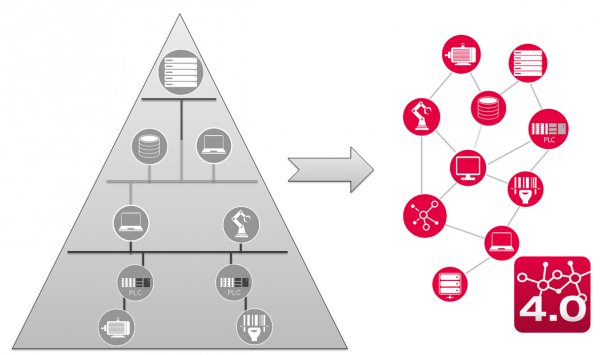
Global availability of information in the context of Industry 4.0: Leuze sends its data to the cloud.
The primary goal of Industry 4.0 is to make information from different sources available and to link it together. First, a distinction must be made regarding the origin of the information. For this purpose, the automation pyramid or the RAMI 4.0 reference architecture model can serve as a guide: on the one hand, there is information generated at the field or control level and, on the other hand, information managed centrally, for example in ERP systems.
It is essential to take into account that the information to be linked is not only available within a single company. The added value and the business models discussed in the context of Industry 4.0 arise largely from the fact that information from different sources is collected at field level and combined with information available at a central level in order to gain new insights.
The first goal must be to make data from different sources available. The next step consists in networking this data in order to ultimately generate new business models from this process.
Leuze has therefore devoted itself to data availability and, for the first time, has put sensor data directly into the cloud, beyond all system boundaries. Leuze integrated an OPC UA server into a sensor and coupled it to Microsoft's Azure cloud using the Publisher-Subscriber model. To enable universal data exchange in all directions, Leuze complemented this implementation with Microsoft's IoT Proxy server, which now makes it possible to carry out client-server communication from the cloud in a way similar to local shop-floor concepts. The big difference compared to these solutions is that this communication, and consequently the data, is available not only locally but also at a global level.
They can thus also be networked globally and beyond the boundaries of plants and companies, for the purposes of interpretation and evaluation.
Global availability immediately raises the indispensable question of data security. OPC UA is certified by the Federal Office for Information Security (BSI) and offers the four security characteristics generally implied for secure communication: authentication, authorization, verification and encryption. Proven methods and procedures from the field of information technology (IT) are thus transferred to the field of automation technology (OT – Operations Technology). All of this is covered by the keyword ?IT2OT? (or ?ITgoesOT?). This raises questions about global authorization methods: authentication will be carried out in the future by means of certificates. Leuze electronic sensors will therefore be equipped in the future with a unique security certificate, in addition to existing identification data such as, for example, their serial number.
To make data available and easily usable in the cloud without having to apply Big Data and neural network technologies to the cloud data, it is essential that the data already be clearly structured at the sender level (for example, a sensor) and transformed into information instead of raw data. Ideally, the goal would be for information from related data sources to have a standardized structure. Various initiatives and approaches have already been undertaken in this context. There will thus be a form of administration shell from the German Electrical and Electronic Manufacturers' Association ZVEI with the OPC UA description model. A complementary application-specific standard will also be defined by the user association ?Advancing Identification matters? specifically for sensors in the field of automatic identification (for example, barcode scanners). The use of device descriptions and application-specific profiles standardizes the interpretation of information. Leuze electronic will implement this standard in its identification products. Direct integration of information from Leuze barcode readers into the administration shell I4.0 is thus possible. ?Direct? means that the information from the sensors is transmitted via OPC UA and can be integrated into the data model of the administration shell without further transformation.
To organize the continuous availability of information, a capability must be created from the cloud that makes it possible to detect and address data sources beyond all system boundaries. The aim here is not to open the way to unprotected access but rather to provide installation support. It is not practicable to manually make a large number of edge devices (for example sensors and actuators) known to a global cloud system or to register them in the cloud system. Instead, technological mechanisms are needed to enable the cloud system to detect by itself the edge devices assigned to it centrally. These mechanisms are referred to as ?Global Discovery? functionalities. There are two different mechanisms that are part of the OPC UA standard: on the one hand, local discovery mechanisms (Local Discovery Server), and on the other hand, global discovery mechanisms (Global Directory Server). These mechanisms require an extensive certificate exchange (Trust List Type) to secure access. In keeping with its promise to customers of ?Smarter Usability?, Leuze electronic sensors will provide all forms of discovery mechanisms with secure access.