












Editorial team · Robotics, Automation, Industrial IT
 InfoWeb Marketplace · Editorial team
Published on 21 June 2009 · 2 min read
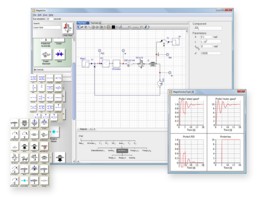
MapleSim, a next-generation modeling and simulation tool
InfoWeb Marketplace · Editorial teamPublished on 21 June 2009 · 2 min read
Maplesoft™ announces the launch of the pilot version of MapleSim™. This new multi-domain modeling tool, with a truly revolutionary design, will considerably reduce product time to market.
Thanks to advanced modeling techniques, users can recreate a system diagram on screen using libraries of components representing physical models. The generation of the equations representing the system, its subcomponents and its dynamic behavior is fully automatic.
?With MapleSim, Maple™, the world's most advanced symbolic computation engine, integrates traditional numerical solvers designed to ?boost’ simulation and modeling processes,? explains Jim Cooper, CEO of Maplesoft.
?With traditional techniques, modeling even simple systems is laborious and very time-consuming, whereas with MapleSim, users simply recreate a system diagram on screen, and the machine automatically generates the model equations. By saving weeks, even entire months of work, MapleSim ushers in a new era of modeling.?
Here are the main advantages of MapleSim compared with traditional tools:
MapleSim allows users to use physical components and traditional signal-flow blocks together
The modeling diagram closely resembles the actual system being modeled
Multi-domain models are assembled seamlessly from pre-existing components
No conversion errors or inconsistencies in unit management
Live design documentation keeps a record of the analysis underlying the development of the model
Automatic generation of systems of equations representing the model
Complex models are automatically simplified using advanced symbolic techniques.
Physical modeling consists of mathematically modeling the dynamic behavior of a system. Previously, this task involved non-automated derivation and manipulation of equations in order to obtain a result usable by signal-flow simulation tools using block diagrams.
However, block diagrams are more complex, more difficult to create and do not resemble the representation of the original system.
But now, thanks to the extremely sophisticated physical modeling techniques used by MapleSim, users can recreate a system diagram on screen using compact, intuitive components representing a physical model, which greatly facilitates its construction and understanding.
MapleSim includes more than 500 components covering more than ten domains such as electrical, mechanical, control design and thermal, all presented as palettes that make navigation easier.
MapleSim automatically generates mathematical equations representing a model, resulting in time savings measured in weeks or even entire months for complex applications. These equations are automatically simplified to produce concise models and high-speed simulations of sophisticated systems.
MapleSim is built around Maple's symbolic computation technology. Unlike purely numerical computation, symbolic technology makes it possible to directly convert the representation of a physical system into mathematical equations.
Models created this way are extremely concise. They do not use iterative numerical routines for solving and guarantee optimal simulation performance without generating the errors systematically encountered with manual derivations.
Advertisement