












Editorial team · Materials, Tools, Components
 InfoWeb Marketplace · Editorial team
Published on 29 March 2013 · 5 min read
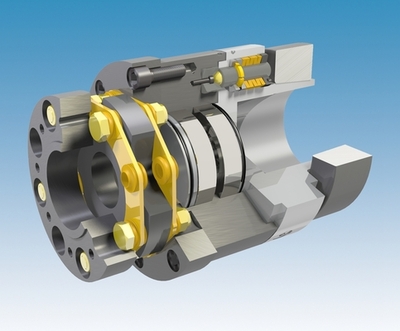
Mayr: New Application Limits for Torque Limiters
InfoWeb Marketplace · Editorial teamPublished on 29 March 2013 · 5 min read
Test bench applications are very demanding on torque limiters, as they quickly exceed the standard designs available on the market. To meet this demand, mayr® has developed new torque limiters suitable for speeds of up to 16 000 revolutions per minute.
As a global market leader, mayr® has for many years offered the widest range of products in torque limiters: load-holding, load-separating, force-limiting, friction-locking, positive-locking, magnetic, controllable and switchable. Despite this wide selection, the company constantly receives requests from various sectors for new torque limiters optimized for specific applications, since the standard ranges available on the market cannot always meet every requirement optimally.
Test bench technology is one of these fields of application. In it, torque limiters must above all be suited to extremely high speeds. In addition, they must be able to transmit torque without harmful backlash and be torsionally rigid. In the event of malfunctions, the protection of high-end systems must be guaranteed. At high speeds, the only effective solution is a disengaging (declutching) torque limiter with no residual torque, which allows the rotational energy stored in the decoupled masses to decelerate freely in the event of overload.
With the EAS®-HSC and EAS®-HSE series, mayr® has developed new torque limiters suited to the extreme demands of test bench technology. Both series are based on design principles proven over decades.
A fundamental prerequisite for using a torque limiter in high-speed applications is a high degree of balancing in each individual component, in order to achieve optimal smooth running of the drive train in combination with the other components. As speed increases, imbalances cause considerable centrifugal forces and vibrations. This puts the test bench structure as a whole at risk, and can lead to irregular operation, which distorts the test results from the measuring instruments. Optimizing mass imbalance was therefore one of the main priorities in developing the new torque limiters.
Compared with standard torque limiters common on the market, the new EAS®-HSC and EAS®-HSE models offer many technical advantages. At first glance, the extremely compact design of the clutches is evident. The high power density reduces the rotating masses and has a positive effect on smooth running and machine dynamics.
The torque limiters contain many components, which must not change position within the clutch once assembled and in the event of overload. Certain design features ensure this. In addition, the clutch is balanced when fully assembled, with a balance of G2,5, at a reference speed of 3000 tr/min.
To ensure that the fully assembled torque limiter, which is set to the respective torque and balanced, also provides the required balance after integration into the customer's system, the clearance between the customer's shaft and the clutch bore is minimized. The clutch bores are made to quality 6 in the standard range. In addition, the friction-locking connection between shaft and hub ensures torque transmission without harmful backlash.
The external reaction forces acting on the output flange of the high-speed clutches are absorbed by a clutch bearing and therefore have no influence on the disengagement mechanism. The precise torque limitation remains intact. If the drive train jams, the torque limiter disengages instantly. The input and output of the high-speed EAS units are accelerated extremely quickly. The high-quality clutch bearing is designed to absorb these accelerations.
After an overload, too, the position of each component relative to the others must not change. When the clutch disengages, the input and output rotate relative to each other. The initial position must therefore be restored precisely after disengagement. For this reason, the new test bench clutches disengage with a synchronous re-engagement system.
On the EAS®-HSC, the torque in normal operation is transmitted via balls that engage simultaneously in the grooves of the hub and the output flange. Disc springs preload the balls via a ring. The degree of spring tension is proportional to the transmittable torque. This method also ensures the absence of harmful backlash if the grooves wear. mayr® uses disc springs with a degressive characteristic curve in its torque limiters. This means that torque is transmitted with torsional rigidity until the preset disengagement value is reached. In the event of overload, the spring preload is reduced and the clutch disengages precisely.
After disengagement, a special disengagement mechanism ensures that the clutch remains in the disengaged position. The drive train can thus decelerate freely. While stationary, there is no impact on the clutch that could have a negative effect on the drive train, in particular on the torque measuring tool. The torque transmission unit is designed so that re-engagement is only possible at the intended disengagement position. This means that each clutch component always has the same angular position relative to the others during operation and that the balance is maintained. The special disengagement mechanism allows easy and fast re-engagement without major effort.
On the EAS®-HSE, each overload element transmits torque via positive locking. In the event of overload, these overload elements disengage and separate the input and output almost without any residual torque, with high disengagement and consistent accuracy. The kinetic energy of the rotating masses stored in the system can thus decelerate freely. The elements do not re-engage automatically. They remain separated until they are re-engaged manually or via a device. The synchronous re-engagement position that maintains the balance is clearly marked on the clutch.
The new test bench clutches are supplied as a flange for attaching the customer's components, or with all-steel single or double-jointed couplings that are torsionally rigid. In addition to the classic connection of two shafts, mayr® supplies adapter flanges to directly integrate standard measuring flanges. This makes extremely compact arrangements possible.
The EAS®-HSC series covers a nominal torque range from 5 to 1 000 Nm, in five sizes. Depending on the size, speeds between 6 000 and 12 000 tr/min are possible. For the EAS®-HSE series, 3 sizes for torque values between 500 and 5 700 Nm have been produced so far. Four additional sizes are planned. The complete series will be able to cover torque values between 300 and 25 000 Nm and speeds up to 16 000 tr/min.
Owing to their characteristics, the new EAS®-HSC and EAS®-HSE torque limiters are not only suited to test benches: they are the ideal solution for all high-speed drive shafts.
Advertisement