












Micro-Epsilon presents its sensors for wind turbine inspection
 InfoWeb Marketplace · Editorial team
Published on 28 February 2019 · 4 min read
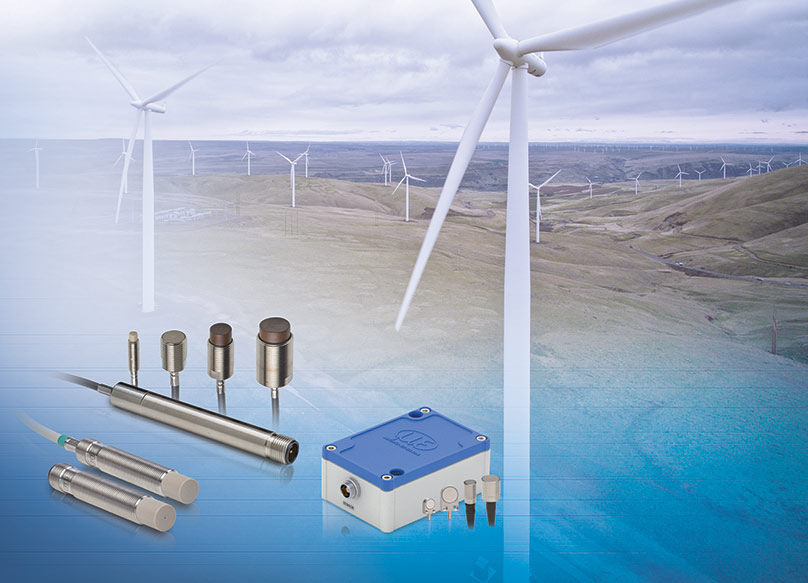
Wind turbines must be monitored 24 hours a day, 24 days a year, for reasons of safety and cost. Lightning, defective rotor blades or tower movements caused by very strong gusts of wind can have serious consequences and may even cause a collapse. Micro-Epsilon's precise sensor technology is already used in production, as well as in the real-time verification of operating installations. The sensors allow timely and rapid intervention in production, or the emergency shutdown of wind turbines in the event of danger or damage. Maintenance and servicing costs are reduced thanks to targeted monitoring using modern sensors.
Wind energy has always been used, for example in mechanical form by windmills or for sailing ships. Today, electricity generation is the main use of wind energy. Wind turbines are used onshore and offshore to produce energy. The rotor towers of these large installations weigh dozens of tonnes and are gigantic in height. The average rotor diameter is approximately 110 m and the average hub height is approximately 130 m. An unexpected failure of such a system results in considerable financial loss. In an emergency, technicians do not have immediate access to cranes and other machinery. Offshore wind farms in particular are not accessible around the clock, day and night. Given the wear and the complexity of the systems, environmental influences are also the cause of many malfunctions.
Shaft problems, transmission errors, gear wear, material fatigue, imbalance, temperature variations, lubrication errors and bearing play disrupt proper operation or cause further damage. Predictive maintenance is therefore crucial in this context. Thanks to precise sensor technology, predictive monitoring already begins during production, through a test bench and real-time monitoring during operation. Wear of parts or production deviations must be detected before more serious damage even occurs. Intervention is therefore possible and anticipates the failure of individual parts or the wear of a tool. Not only are actual conditions documented, but trends based on the evolution of the measured variables can also be analyzed and evaluated. Maintenance can be planned, and emergency shutdowns and downtime of large installations are thus kept to a minimum. Productivity is optimized while using resources efficiently and reducing costs.
Measuring the displacement of the coupling ring
At more than 100 meters in height, the very powerful wind energy acts on the rotor blades, the housing and the tower. The gearbox and the generator are therefore elastically mounted. Couplings in wind turbines must therefore compensate for the relative movements of the gearbox and the generator. To measure the displacement of the coupling ring, distance measurement with eddy current sensors is carried out on the metallic coupling ring. This determines the load profile. Monitoring the measured values is necessary to avoid unnecessary wear of couplings, bearings or shaft seals, or even major damage to the wind turbine in extreme cases. Measurement is carried out in different directions: axial, radial and tangential. The eddy current sensors of the eddyNCDT series 3001 and 3005 are temperature-compensated and therefore offer high stability, even with large variations in ambient temperature. They are already factory-calibrated for ferromagnetic and non-ferromagnetic materials, so on-site linearization is no longer necessary.
Thanks to factory calibration, the eddyNCDT sensors 3001 and 3005 offer high precision and thermal resistance that are particularly advantageous for continuous use in industrial environments. The thread M12 makes it possible, among other things, to replace the sensors quickly. They have a robust design according to IP67 and can be integrated into the smallest installation spaces thanks to their compact design with integrated electronics. For this purpose, the sensors are mainly used for preventive monitoring of wear and structural condition. Compared with inductive switches and sensors, these models offer a higher bandwidth and are therefore ideally suited to monitoring and precisely detecting rapid movements.
Measuring the gap on the plain bearing
Hydrostatic bearings are very often used in large installations such as stone mills, telescopic installations or wind turbines. The measurement task is to monitor the size of the gap between the bearing surface and the shaft. The lubrication gap contains an oil film that prevents direct contact between the bearing surface and the shaft. In the event of a hydraulic system malfunction, the oil pressure may drop and the gap may close in extreme cases. The consequence would be damage to the bearing, which in turn would lead to system failure. The sensor is mounted on the side of the bearing pad. It measures through the oil film and the plain bearing layer, directly onto the shaft. For this purpose, the non-contact eddy current displacement sensors of the eddyNCDT series 3001 and 3005 are used.
They are distinguished by their robust and compact construction with integrated controller. Micro-Epsilon eddy current sensors are generally used for applications in harsh environments requiring very high precision. They are particularly resistant to high pressures, lubricants and extreme temperatures. Another requirement for the sensor technology is rapid commissioning and the option of retrofitting existing systems. Because the systems are used worldwide, simplified sensor replacement is essential.
Monitoring the air gap in the generator
With large generators or electric motors, it is essential to determine the rotation of the rotor inside the motor relative to the stator. Because of imbalance during operation, which occurs in wind turbines, among other reasons due to wear caused by extreme wind and weather conditions, the rotor may touch the stator, which would cause major damage. Thus, during operation, optical and capacitive sensors monitor the gap between the stator and the rotor, known as the rotor gap. Capacitive sensors with a measuring range from 0 to 8 mm perform this measurement task.
