












MiR launches an even higher-performing collaborative mobile robot
 InfoWeb Marketplace · Editorial team
Published on 16 July 2018 · 3 min read
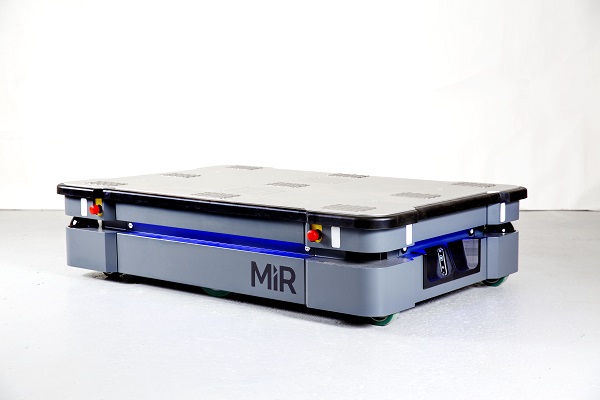
As the leader in the collaborative mobile robot market, Mobile Industrial Robots (MiR) is now responding to a major industrial need. Its flagship robot is now available in a new version that is larger, sturdier and faster. A solution that adapts to a greater number of applications.
Today, MiR launched its latest innovation, MiR500, at the largest European trade fair dedicated to robotics and intelligent automation.
This robot has a lifting capacity of 500 kg. It can automatically pick up, transport and deliver pallets at speeds of up to 7,2 km/h. Industry can now optimize its logistics operations across the entire production chain, from the warehouse to the delivery of goods, thanks to a complete fleet of flexible MiR robots suited to both heavy and light transport.
?With the MiR500 robot, we continue to offer the robust, proven technologies, as well as the safety features, that have allowed us to establish ourselves as the world's leading supplier in the autonomous mobile robot market. The MiR500 robot was developed taking into account the needs observed among current and potential customers. They have tested our other robots and now see the considerable potential offered by automating the internal transport of heavy items and Euro pallets. With MiR500, we are setting new standards for the ways in which companies can use mobile robots,? said Thomas Visti, CEO of Mobile Industrial Robots.
To move pallets and heavy items efficiently and safely
As with the other MiR robots, the MiR500 model can safely navigate around people and obstacles. Incorporating sophisticated MiR technologies and cutting-edge software, the MiR500 robot can detect any obstacle within a 360° range and navigate autonomously to find the most efficient route to its destination, even in dynamic environments where people and vehicles are moving about.
This collaborative mobile robot is designed to meet all the rigorous safety standards required for TÜV certification. The technologies are essentially the same as those used in the MiR100 and MiR200 robots, models that are already optimizing the production processes of some of the largest multinationals around the world. The difference lies in the dimensions, the lifting capacity and the fields of application.
?The MiR500 is a very sturdy robot, with an even more robust design than our previous models. It is therefore the ideal solution in industrial environments. We have also incorporated the principles of the MiR100 and MiR200 models, in which flexibility and ease of use are key features. In other words, the MiR500 robot can be configured without any prior experience in the field. At the same time, the top modules are easy to develop and replace, so the robot can be used for different transport purposes. For example, it can be fitted with a forklift, a belt conveyor or a robot arm,? added Thomas Visti.
The MiR500 robot is the same size as a standard Euro pallet. Indeed, MiR expects that most of the MiR500 robots sold will be used to transport pallets in industries and warehouses around the world. Pallets are transported using specially designed MiR frames and lifts, which ensures stable transport and handling. The high speed of the MiR500 makes it possible to standardize pallet transport in all types of companies, and also to reassign employees to more useful activities.
A booming market
According to the International Federation of Robotics, the mobile robot market is expected to grow dramatically in the near future.
?Industry is looking for new ways to optimize production and strengthen competitiveness. Internal transport is the last area of automation that remains to be developed. We are bringing our collaborative mobile robots to market at the ideal time,? said Thomas Visti.
MiR increased sales of its robots fivefold in 2015-2016. Its revenue doubled to 77,5 million Danish kroner in 2016-2017. Compared with last year, the company has based its budget on revenue twice as high in 2018. MiR plans to recruit new staff, growing from 65 to 120 employees in 2018.
For more information:
