












Editorial team · Power transmission, Mechanical components
 InfoWeb Marketplace · Editorial team
Published on 4 April 2022 · 2 min read
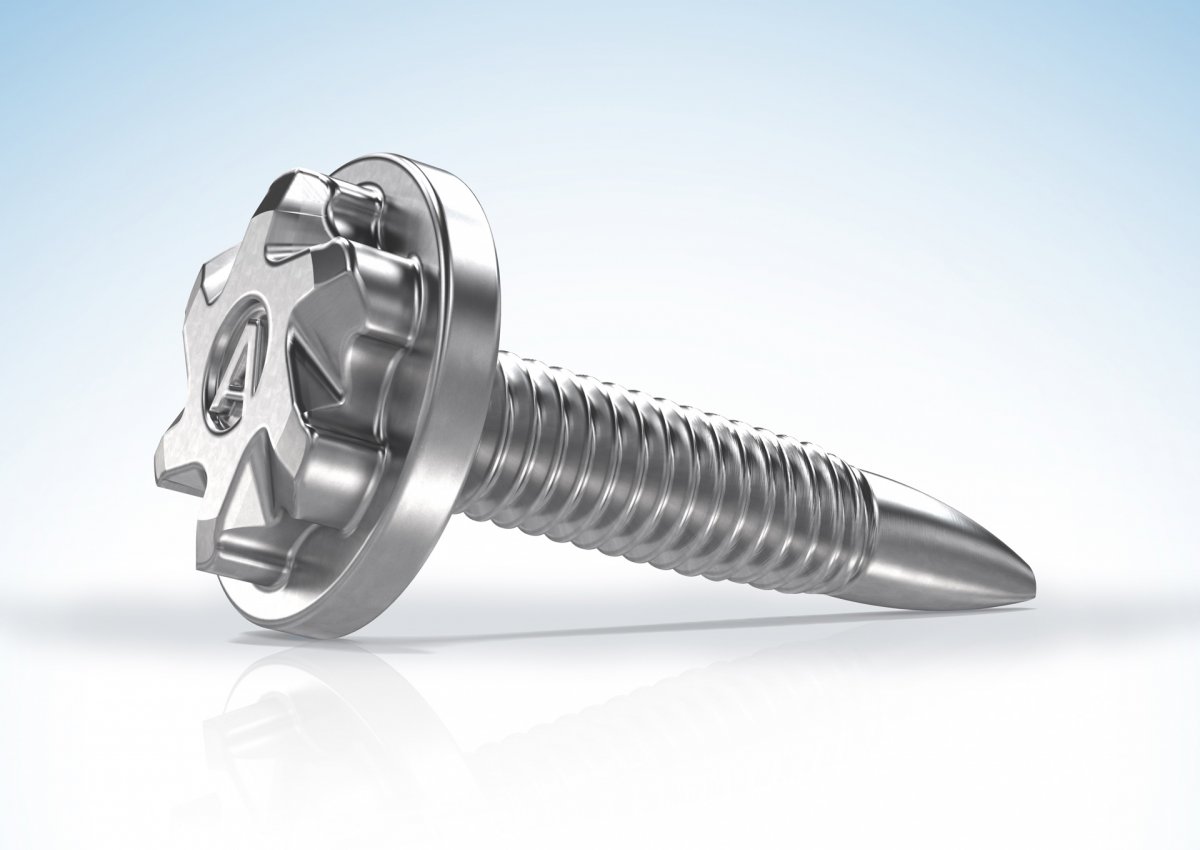
With Flowform Plus, a variant of the Flowform flow drill and thread-forming screw, Arnold Umformtechnik GmbH & Co. KG responds to the demand for enhanced characteristics. With the standard version of Flowform, the maximum joining limit for steel sheets of 1,5 mm thickness is 600 MPa. With Flowform Plus, it now reaches 1 000 MPa.
For Flowform Plus, Arnold's engineers opted for a diameter of 4 mm, compared with 5 for the standard Flowform model. Depending on the head and length, the conventional version of Flowform 5.0 weighs approximately 4 grams, compared with 3 for the new Flowform Plus 4.0. The weight reduction is therefore 25 %. In addition, the geometry of the flow drill point has been optimised and the heat treatment process adapted, thus achieving comparable performance.
The Flowform Plus screw is primarily designed for high-strength steel sheets and thicker sheet combinations. The use of aluminium components also means that joining thicker combinations with several layers may be necessary. Previously, for three-layer joints, the top and middle layers had to be pre-drilled. Now, with Flowform Plus, Arnold Umformtechnik states that, depending on the materials being joined, thicker material combinations (up to 7,5 mm) can be joined without pre-drilling.
This innovation is due to the reduced displacement of materials thanks to the smaller diameter. As a result, the formation of gaps between the sheets is reduced. The reduced diameter also helps to reduce friction. The thread-forming torque is therefore lower than that of the standard Flowform 5. As the torque level is reduced in this case, a lower tightening torque can also be used for the joint. According to Arnold Umformtechnik, although the strength of the joint is lower than that provided by the Flowform 5, it remains sufficient for the application.
The manufacturer also states that the smaller head diameter of Flowform Plus makes it possible to optimise the design of the joint on the customer side. For example, flanges can be made narrower, and thus optimised in terms of weight. Compared with the standard Flowform, the axial force is reduced for similar material combinations, thanks to the low penetration of the materials. The process load can thus be reduced. A smaller robot can therefore be used if necessary. When the same robot is used, the load on the screw during joining is reduced. Another advantage: the user can continue to use the same equipment for fastening. No major modification of the equipment is required.
New Arnold flow drill screw that multiplies application possibilities
InfoWeb Marketplace · Editorial teamPublished on 4 April 2022 · 2 min read
The automotive industry is focusing on weight reduction. Thinner, stronger steel and aluminium are increasingly used, and a growing number of designs use mixed materials. In this application context, new fasteners must guarantee reliable joints.
For Flowform Plus, Arnold's engineers opted for a diameter of 4 mm, compared with 5 for the standard Flowform model. At the same time, the geometry of the flow drill point has been optimised and the heat treatment process adapted to ensure almost equivalent performance. Photo: Arnold Umformtechnik
Flowform Plus, NEW variant of the Flowform flow drill and thread-forming screw
With Flowform Plus, a variant of the Flowform flow drill and thread-forming screw, Arnold Umformtechnik GmbH & Co. KG responds to the demand for enhanced characteristics. With the standard version of Flowform, the maximum joining limit for steel sheets of 1,5 mm thickness is 600 MPa. With Flowform Plus, it now reaches 1 000 MPa.
For Flowform Plus, Arnold's engineers opted for a diameter of 4 mm, compared with 5 for the standard Flowform model. Depending on the head and length, the conventional version of Flowform 5.0 weighs approximately 4 grams, compared with 3 for the new Flowform Plus 4.0. The weight reduction is therefore 25 %. In addition, the geometry of the flow drill point has been optimised and the heat treatment process adapted, thus achieving comparable performance.
Flowform Plus, designed for steel sheets and thick sheets
The Flowform Plus screw is primarily designed for high-strength steel sheets and thicker sheet combinations. The use of aluminium components also means that joining thicker combinations with several layers may be necessary. Previously, for three-layer joints, the top and middle layers had to be pre-drilled. Now, with Flowform Plus, Arnold Umformtechnik states that, depending on the materials being joined, thicker material combinations (up to 7,5 mm) can be joined without pre-drilling.
This innovation is due to the reduced displacement of materials thanks to the smaller diameter. As a result, the formation of gaps between the sheets is reduced. The reduced diameter also helps to reduce friction. The thread-forming torque is therefore lower than that of the standard Flowform 5. As the torque level is reduced in this case, a lower tightening torque can also be used for the joint. According to Arnold Umformtechnik, although the strength of the joint is lower than that provided by the Flowform 5, it remains sufficient for the application.
The manufacturer also states that the smaller head diameter of Flowform Plus makes it possible to optimise the design of the joint on the customer side. For example, flanges can be made narrower, and thus optimised in terms of weight. Compared with the standard Flowform, the axial force is reduced for similar material combinations, thanks to the low penetration of the materials. The process load can thus be reduced. A smaller robot can therefore be used if necessary. When the same robot is used, the load on the screw during joining is reduced. Another advantage: the user can continue to use the same equipment for fastening. No major modification of the equipment is required.
