












Norelem: Are toggle clamps catching your attention?
 InfoWeb Marketplace · Editorial team
Published on 27 February 2020 · 4 min read
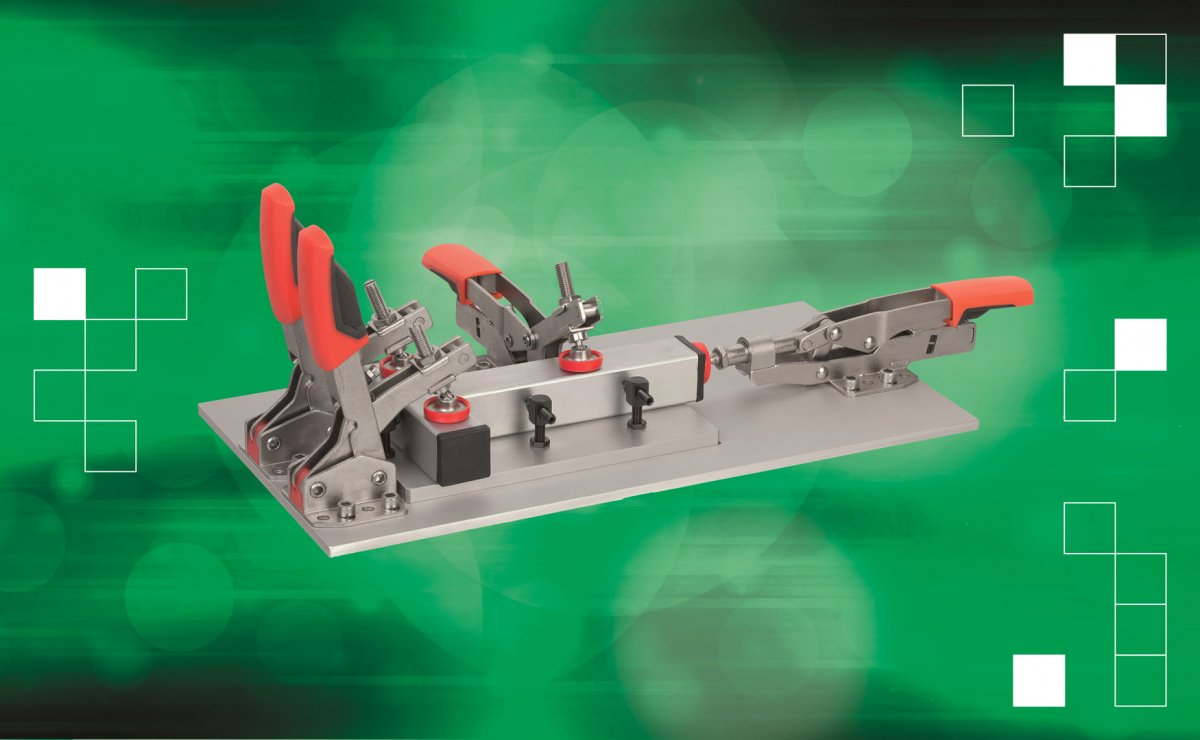
Despite being widely available and suitable for many applications, toggle clamps are often overlooked and do not spontaneously come to the minds of manufacturing engineers. Marcus Schneck, CEO of norelem, explains the best uses for toggle clamps and what they can bring to their users. Hold-down clamps, cam clamps, stepped clamps, eccentric clamps... in the world of workholding and clamping elements, we are spoilt for choice.
However, just as one size does not fit all, a clamp cannot meet every application. Yet we can often fall into the trap of using only the clamping elements we know well and trust. This is quite natural, after all: aren't we said to be creatures of habit? Nevertheless, by falling into a routine, efficiency can drop, the clamping solution chosen may not be optimal and defects may appear.
As an example, a few clamps were selected for one of the largest recent engineering projects in Canada. Known as the ?big lift?, the Angus L. Macdonald Bridge in Halifax had to be lifted and its road surface replaced. During this work, a near-accident occurred. When the workers tried to release a clamp, it sprang off and landed on the deck because it was under load. Although nobody was injured, the entire site was shut down until a safe solution was found. This was of course a high-level engineering project with many parameters and great complexity, but the principle remains the same: a poor clamping choice can cause difficulties during work, not to mention safety issues. This is where toggle clamps come in. Although they exist in many forms and types for a wide variety of applications, they are not widely recognised for clamping in industrial engineering. Here is why you should give them the consideration they deserve.
High clamping power at low cost
Toggle clamps offer some of the highest clamping forces available. They work by leverage and can be operated with little effort. Their working principle is to apply pressure through leverage to secure the component in question. Once the three points of the joint are aligned (when the lever is raised and locked), the workpiece can no longer react with an opposing force. Self-locking is guaranteed as soon as the dead centre is passed (alignment of the three joints), while the clamping force can be adjusted using the adjusting screw. Toggle clamps are the optimal solution for drilling, welding, grinding and inspection operations. In the woodworking industry, they prevent extreme deformation when gluing or assembling fragile sheets, since the clamping force is controllable.
A marked contrast with other clamping methods
Toggle clamps are used in a single operating sequence. They are positioned before clamping and are then folded down to lock the component. The clamping force is preset beforehand on the clamping screw through the arm. In this way, the clamping force is guaranteed. The contrast with other clamping methods, such as hold-down clamps, is marked. Hold-down clamps work in compression and are tightened by hand like a vice. Of course, this type of clamp introduces a human element, in that it is up to each person to judge whether the clamping is strong enough. Clamping judged sufficient by one person may not be by another. Compression-based clamping systems can also make it difficult to assess whether the clamping is too strong, which can cause inefficiency. Over-clamping can also mark the workpieces.
Flexible, ergonomic, self-adjusting
One of the major features of toggle clamps is their flexibility. In the norelem range, they are available for vertical, horizontal or angular locking, in small or large sizes. They can also be supplied in a push-pull version for mounting on a support. All this means that toggle clamps can be used for virtually all everyday applications. In addition, the handles can be supplied with ergonomic grips. This relieves operators of repetitive musculoskeletal disorders, especially when they work on large batches of parts.
Another benefit of toggle clamps is that they can be self-adjusting, like those in the norelem range. These toggle clamps automatically adjust to the height, width or depth of the workpiece and offer an infinite number of clamping positions over 35 mm, without having to readjust the clamping screw. The clamping force can be set up to 1000 newtons via a screw located under the lever in the hinge, so that the workpiece is secured. Self-adjusting toggle clamps are recommended when operators work on large volumes in machining and milling, with parts of varying dimensions. This avoids having to adjust the clamp manually by tightening the clamping screw.
Switching to more efficient engineering
Two of the basic principles of engineering are problem solving and ?keeping it simple?. Toggle clamps meet both when they are properly considered. Design engineers should consider whether a toggle clamp could be a simpler and more efficient clamping solution. Instead of using multiple hold-down clamps, wouldn't it be better to use a toggle clamp instead? From this perspective, toggle clamps are not only a potentially better solution, but they can also reduce costs. Less investment in clamping, fewer injuries and physical strain, and a more efficient workforce mean both better production and increased profits.
