












Editorial team · Power transmission, Mechanical components
 InfoWeb Marketplace · Editorial team
Published on 8 October 2012 · 2 min read
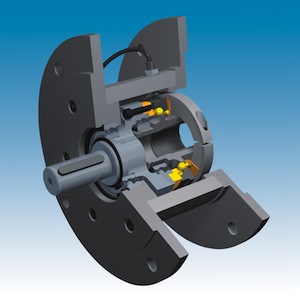
Overload protection with EAS®-HTL integrated clutches
InfoWeb Marketplace · Editorial teamPublished on 8 October 2012 · 2 min read
Owing to growing demand for corrosion-protected torque limiters in higher power ranges, mayr® power transmission is adding a further size to the proven EAS®-HTL range, doubling the torque range of these integrated clutches from 1 200 to 2 400 Nm.
Corrosion-protected torque limiters that prevent overload damage have proven their worth in many types of applications in which moisture and contaminants are part of everyday ambient conditions. In the event of malfunctions and shocks, they limit the torque of the drive train to a given value, thus preventing the most costly damage, downtime and repairs.
The integrated clutches of the EAS®-HTL range can also be retrofitted to existing designs and systems. The dimensions of the housing flanges and shafts comply with IEC/B5 and NEMA standards. The extremely short overall length of the EAS®-HTL models makes them easier to integrate with existing motors. In addition, the high rigidity of the hardened steel housing makes it possible to attach suspended loads. The closed housing prevents moisture and contaminants from penetrating and prevents lubricants from washing out of the installed EAS®-NC or EAS®-Compact® torque limiters.
In normal operation, these torque limiters transmit torque without detrimental backlash throughout the service life of the equipment; they are therefore also suitable for demanding, dynamic motor concepts. They are set to the torque requested when the order is placed at the place of manufacture. If the torque is exceeded due to an overload or a shock, the clutches disengage, separating input from output in just a few milliseconds. An integrated sensor detects the disengagement movement and emits a signal, which can be used, for example, to stop the motor. The disengagement time depends on the rigidity of the axis, as well as on the force and speed of the shock.
At the moment of disengagement, disc springs with a negative characteristic curve ensure that the torque is reduced immediately, and not only after an excessive increase in torque. This factor must be taken into account when using many other ball detent torque limiters. The type of re-engagement after the overload depends on the design of the torque limiter integrated in the EAS®-HTL.
Slip-type limiters re-engage in any position and are immediately ready for operation again. Synchronous limiters behave in a similar way, except that they can only engage in precisely defined positions on the input and output sides. Overload limiters, however, remain disengaged until they are re-engaged manually or with suitable devices. The stored energy of the rotating masses can dissipate freely. The disengaging design is preferred for large mass inertias and high speeds.
