












Editorial team · Detection, Measurement
 InfoWeb Marketplace · Editorial team
Published on 6 December 2012 · 1 min read
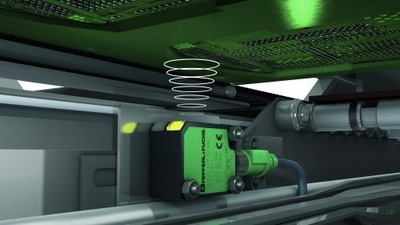
Pepperl+Fuchs miniature ultrasonic sensor F77
InfoWeb Marketplace · Editorial teamPublished on 6 December 2012 · 1 min read
Level control of a water tank is one of the classic applications of ultrasonic sensors. A sensor in a M30 ring can easily measure heights of up to four to six meters. If the pump is controlled by a PLC, installing the sensor is limited to mounting and wiring it to the controller. The measured value is transmitted via an I/O link or analog output, then processed in the controller.
With stand-alone solutions, additional steps are required to configure the sensor. The choice between a filling or emptying threshold, the hysteresis value for pump activation and the optional addition of an averaging function to increase the accuracy of the measured value during filling can be set easily using parameterization software. Objects causing interference, such as a ladder, can be effectively suppressed by reducing the diameter of the conical beam. The intuitive parameterization software makes it possible to adapt the sensor to specific tasks.
In addition, ultrasonic sensors can perform certain simple tasks with great reliability, for example detecting printed circuit boards in an assembly machine. The sensor's task is to accurately detect the edge of an approaching circuit board. Notches in a circuit board and shiny or differently colored surfaces pose no problem for **miniature ultrasonic sensors F77**. Their projected beam ignores the notches and reliably detects the edge. Simply entering the position of the circuit board is enough to configure the sensor for the task at hand.
Two decades of development at Pepperl+Fuchs have optimized ultrasonic
technology, making it easy to use in many applications. Ultrasonic sensors can be precisely adapted to given tasks and conditions using intuitive parameterization tools. Simple and economical, they only need their operating distance to be defined to perform their task reliably.
