












Porsche to use AGVs in its continuous-flow production line
 InfoWeb Marketplace · Editorial team
Published on 25 April 2019 · 4 min read
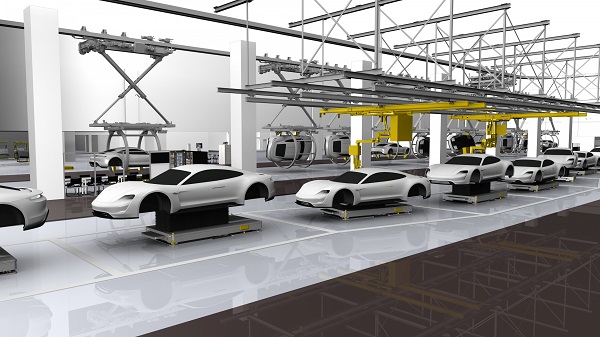
For the manufacture of the Taycan electric vehicle, Porsche will use AGVs in its continuous-flow production line for the first time.
AGV fleet management in modern automotive production
New manufacturing concepts aim to increase the automation and flexibility of assembly lines, from series production to one-off production. Innovative concepts centered on fleets of AGVs (automated guided vehicles) are being tested in the automotive industry, as is currently the case at Porsche. This requires flexible communication in assembly workshops, by radio directly into the IT network.
In the modern automotive industry, manufacturers are working on production concepts that require no stationary conveyor lines, such as assembly lines or overhead conveyors. Several manufacturers are currently gaining experience with such concepts at pilot sites.
The Fraunhofer IPA institute in Stuttgart recently implemented AGV-based automotive production in its research center ?Arena 2036?. And not far from there, in Stuttgart, the Porsche Taycan will be built using this new process by the end of this year. Porsche is moving away from the manual ?assembly line? mode and will be the first car manufacturer to introduce automated transporters in continuous-flow series production. The new production technology, currently being tested and soon to be implemented, requires new, suitable components, such as AGVs for example, but also new communication methods, because most of these components are mobile and ultra-flexible. This applies not only to the AGVs on which the vehicle is assembled, but also to the mobile racks that supply the AGVs with raw material.
To provide such functions, namely the transmission of data from radio sensors on mobile units to the IT infrastructure, the steute Wireless division has developed a radio network for data exchange. It consists of network-compatible radio transmitters (limit switches, foot pedals, magnetic or optical sensors, etc.) that exchange data through a mesh of modems/routers. Each router/access point can manage around a hundred networked sensors, and the entire network can consist of several dozen access points. The master router, called the ?Sensor Bridge?, acts as a data collector: it processes the information generated at production level and forwards it to the company's IT network. The ?Sensor Bridge? is configured through supervision software via a web interface. Users can thus adjust the functions of the radio network to the individual needs of production. An additional advantage: this network can be used for multiple applications, such as AGV fleet management or e-Kanban mobile racks...
Multi-protocol radio technology
Originally, steute developed the proprietary wireless protocol sWave.NET® in-house. It is a low-power wide-area network (LPWAN). Among other things, this offers the advantage of operating on very low power with long range, even under unfavorable conditions, as well as high transmission reliability. This is why the battery life of these radio sensors can reach ten years. The reliability of the protocol is ensured by multiple transmissions in case an exchange fails. If transmission to the first access point fails, the second access point is called upon, and so on. However, in some applications, operators wish to forgo these advantages, because it is more important to them to use existing standards for radio signal transmission, for example their internal Wi-Fi network. The wireless network is an open network and offers, under the ?nexy? brand, an open technology platform for the wireless transmission and processing of radio sensor data from the workshop to the company's IT infrastructure (AGV fleet management, SGE, BDE, MES, ERP) and even beyond, into the ?Internet of Things? (IoT).
Some ?nexy? application modules are already in service, for example the AGV fleet management software. An additional software module for e-Kanban systems will be presented at the upcoming intralogistics trade shows.
Wireless network for AGV fleets
The company DPM is among the specialists in AGV systems for automotive applications and has developed a new AGV concept designed specifically for the assembly of electric vehicles, called Vision E. One of the special features of the Vision E is its on-board safety principle, which, according to the manufacturer, allows assembly work to be carried out all around the vehicle on the assembly line. The assembly line is therefore never interrupted.
The battery management system is another DPM specialty. In traditional installations, power is supplied by batteries that must be switched off and restarted manually on each AGV, or even recharged after long periods of inactivity (some stoppages can last up to three weeks). Using nexy technology, the power supply of the AGVs can be switched off or reactivated by radio command, thanks to a small receiver fitted directly on the AGVs. A small buffer battery remains permanently in operation and powers this radio receiver, which triggers the remote ?wake-up? of the AGV batteries after receiving the centralized radio signal from the sWave.NET® network.
The main advantage is that AGVs do not have to systematically return to a charging station after a long period, but can remain parked in any position and resume work. DPM thus has multiple nexy solutions for managing other types of AGVs and other types of installations.
One protocol - multiple applications
In a next step, this radio network will be extended with other functions, for example automatic replenishment requests for vehicle assembly. In this case, e-Kanban shelves, fixed or mobile, or installed on AGVs, would detect the presence or removal of bins and pass this information to the production flow management software. Another solution consists of installing wireless sensors at the transfer points of fixed and mobile conveyors, which can, for example, signal that a bin is ready to be transported, in order to generate a pick-up order and start the AGV.
With nexy, users benefit from great flexibility of use thanks to intelligent radio sensors, productivity gains thanks to the supervision software, and lower costs thanks to the optimization of assembly lines.
