












Robotics is evolving: victory belongs to those who adapt the fastest
 InfoWeb Marketplace · Editorial team
Published on 24 March 2024 · 4 min read
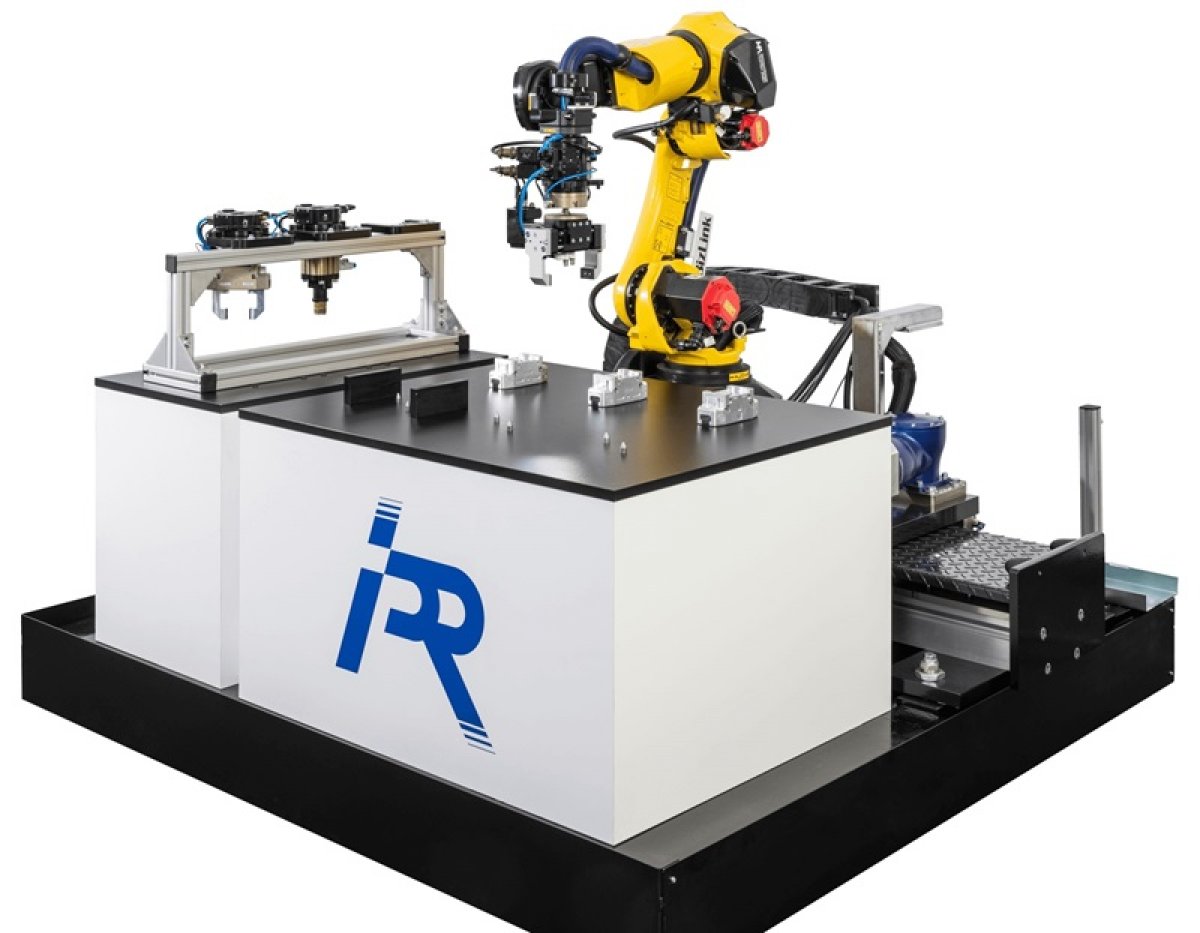
In industry and logistics, robots often perform monotonous tasks that they can repeat almost endlessly with constant precision. Thanks to a new type of tool changer, a high-volume specialist can become a flexible all-rounder capable of economically producing small series and one-off parts.
The IPR specialists are behind the innovative TKX series of automatic changers, whose electric drive is provided by a FAULHABER motor.
The range of tasks performed by robots has become unlimited. It includes gripping, holding and handling operations such as clamping and screwing, as well as foaming and welding. Moreover, in standardized mass production, specialized robots can be used that perform the same tasks day and night. However, many processes require flexibility, particularly when it comes to batch sizes of 1. This is also essential in order to limit investment costs. The wider the range of possible tasks for a robot, the better.
This is where the TKX tool changer comes in. Mounted at the end of the robot arm, it can pick up a multitude of different tools from a rack. For example, it allows the robot to grip and position a workpiece, machine it using tools, and then check and document the quality by means of a contour sensor or a camera. To do this, the adapter needs suitable feedthroughs for the corresponding tool functions. The TKX series offers every conceivable option, as well as several screw-on side surfaces for additional modules. But the main task of the tool changer is to lock the tool securely when it is picked up and to release it quickly and reliably when it is put back after use.
Pneumatic or electric solution?
Traditionally, many industrial applications use pneumatic power transmission for this process. Compressed-air technology has proven itself over decades and is perfectly suited to handling very heavy objects. But a pneumatic system requires compressors, lines and its own control system with numerous mechanical components. It represents a considerable investment in new equipment. In sectors with heightened cleanliness and hygiene requirements, such as microelectronics or the food industry, the pneumatic solution is often ruled out because of the unavoidable compressed-air exhaust. It is even strictly prohibited in cleanrooms.
IPR (Intelligent Peripherals for Robots), based in Eppingen, Germany, has noted a significant trend towards preferring electric drives over pneumatic ones: ?In addition to hygienic safety, electric motors offer markedly greater flexibility of use. Unlike compressed-air connections, power sockets are found almost everywhere. In recent industrial installations, pneumatic systems are generally no longer installed. For cobots and small robots, as well as for decentralized sites, the electric version is almost always the best solution.?
?The fact that the electric drive is now a genuine alternative to the pneumatic system is also related to motor technology,? explains Roman Batz, development engineer at IPR. ?Great progress has been made in recent years. For our applications, we need high power in very compact dimensions. FAULHABER offers motors that can easily compete with pneumatic drives.?
Opening, closing and holding
The most powerful electric model of the TKX series, the TKE 300, can handle objects weighing up to 300 kg. In metal processing, robots handle heavy loads, such as cast iron blocks or large forgings. The tensile force of their total mass then acts on the locking ring of the TKX changer. The torque supplied by the motor at standstill would already be sufficient for secure holding. But IPR has added a self-locking kinematic device, developed in-house, to ensure particularly reliable fixing.
A brushless motor from FAULHABER's BXT family provides the driving force for opening, closing and holding. Thanks to its external rotor technology, it offers a torque-to-weight and torque-to-volume ratio unmatched on the market. This power density is one of the prerequisites for the unique selling point of IPR's new product range, which Roman Batz describes as follows: ?The TKX series are the first tool changers on the market available on the same platform with both pneumatic and electric drives. Our range also includes a manual version. This means that the entire range of accessories can be used with all drive types without retooling. Switching to electric operation is also very easy. This opens up new possibilities for robotic automation.?
Reliable and easy to combine
The TKE changers will be available in seven sizes for handling workpieces from 3 to 300 kg. The electric variant of the range thus covers a wide variety of applications, from lightweight robots to stationary applications. The dimensions of the BXT motors used are matched to the application. ?The variety of sizes and the wide choice of suitable gearheads for optimal reduction in each case were important criteria for us,? explains Roman Batz. ?Robots must be able to achieve cycle counts in the millions without maintenance. A brushless motor with the best possible processing quality must therefore be used. This motor must be easy to control and manage without an additional controller - the integrated speed controller takes care of this. Finally, the components must be able to withstand temperatures of up to +80°C.?
IPR buys all its micromotors from FAULHABER. ?The collaboration began many years ago, long before I arrived,? says the development engineer. Besides the unique quality of the products, other aspects play an important role for him: ?It starts with the very simple configuration of motor-gearhead combinations on the FAULHABER website. A few clicks are enough to get a complete overview. The technical details are very well documented, and when it comes to precisely calculating specifics such as efficiency, power consumption or temperature development over time, I always get the help I need.?
