












Seco Tools' Tool Reconditioning Service Experiences Strong Growth
 InfoWeb Marketplace · Editorial team
Published on 3 January 2023 · 2 min read
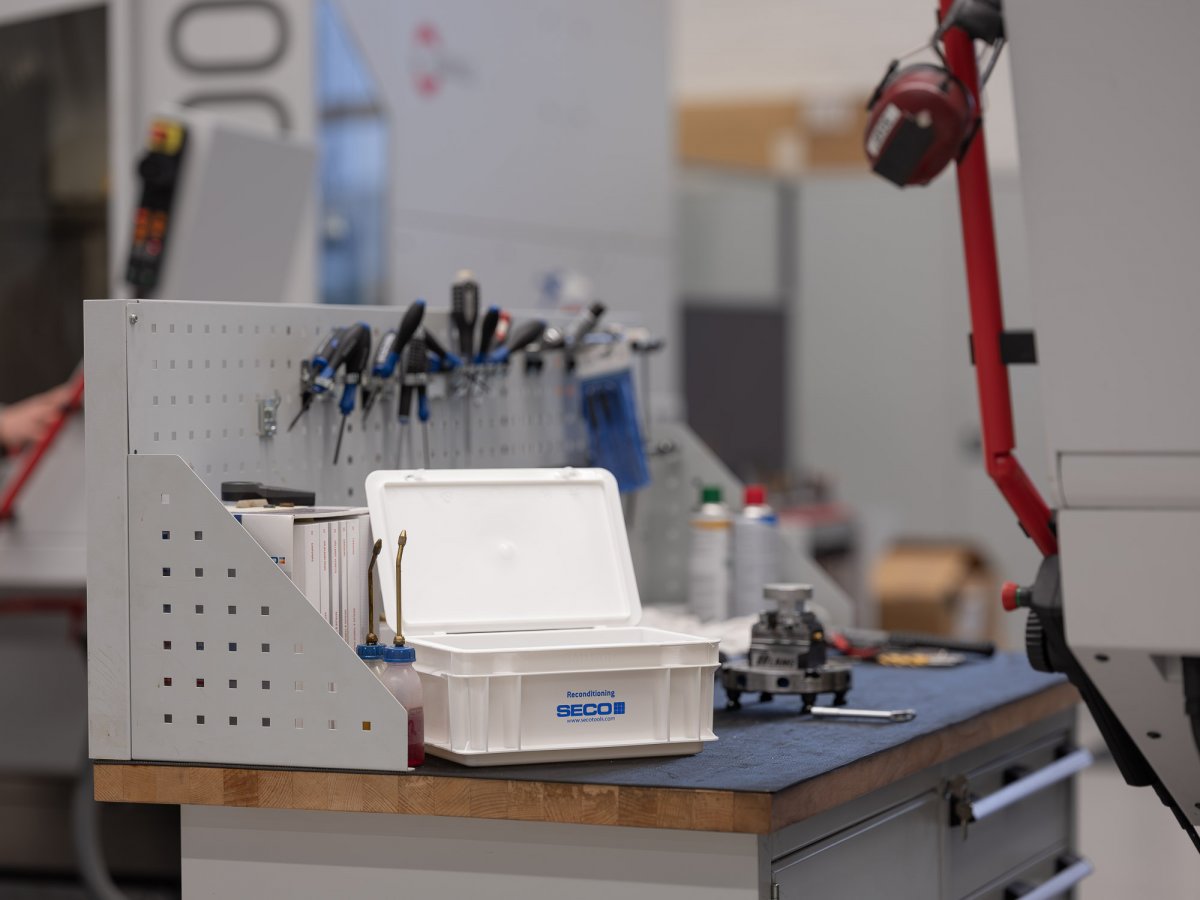
As the fastest-growing area of the Seco Tools portfolio, solid carbide end mills and drills have driven an increase of more than 30 % in use of the company's tool reconditioning service in 2022.
In addition to significant savings for customers, a reconditioned Seco tool regains 85 to 95 % of its original performance, compared with re-sharpened tools. Without having to readjust its parameters or compromise on performance, the reconditioned tool is up to the demands of today's advanced machining strategies, for example dynamic milling, where only a small part of a tool's diameter is engaged in the cut. Manufacturers also strengthen their sustainability strategy and help reduce emissions per part, as well as those generated by producing new solid carbide tools from raw materials.
Tool reconditioning vs. tool re-sharpening
During the re-sharpening process, the cutting edges of a tool are sharpened. Seco reconditioning, by contrast, restores solid carbide tools to a level close to their original condition in terms of properties and performance. This level of quality guaranteed by Seco is a factor that workshops now demand, particularly when considering process stability for automated and unmanned operations.
Benefits of the Seco tool reconditioning process
When Seco reconditions a tool, it applies the same process as that used to manufacture new tools. This includes all relevant grinding steps on the same type of machine with the same programs, the same types of grinding wheels, and the reapplication of the coatings that were applied when the tool was manufactured. Seco identifies the tool and its reconditioning program that meets all the specifications for an original/like-new tool, and applies all the necessary micro and geometric properties.
Furthermore, Seco reconditioning can generally be applied to the same tool two or three times in order to considerably extend its service life. According to Ruud Zanders, Global Reconditioning Manager at Seco Tools, each of these reconditioning cycles is carried out at a cost two to three times lower than the price of a new tool. ?The savings,? he says, ?are simply represented by the equation 1+3=2 (the cost of one new tool plus three reconditioned tools equals the price of two new tools).?
Tool reconditioning contributes to a circular economy
Contributing to the three core principles of the circular economy (eliminating waste and pollution, circulating products and materials, regenerating nature), the Seco Tools reconditioning program helps workshops optimize the life cycle of solid tools, extend product usage time and reduce environmental impact. Thanks to reconditioning, tools can be reused before being recycled.
