












Surface pretreatment by plasma jet from Plasmatreat
 InfoWeb Marketplace · Editorial team
Published on 1 May 2017 · 3 min read
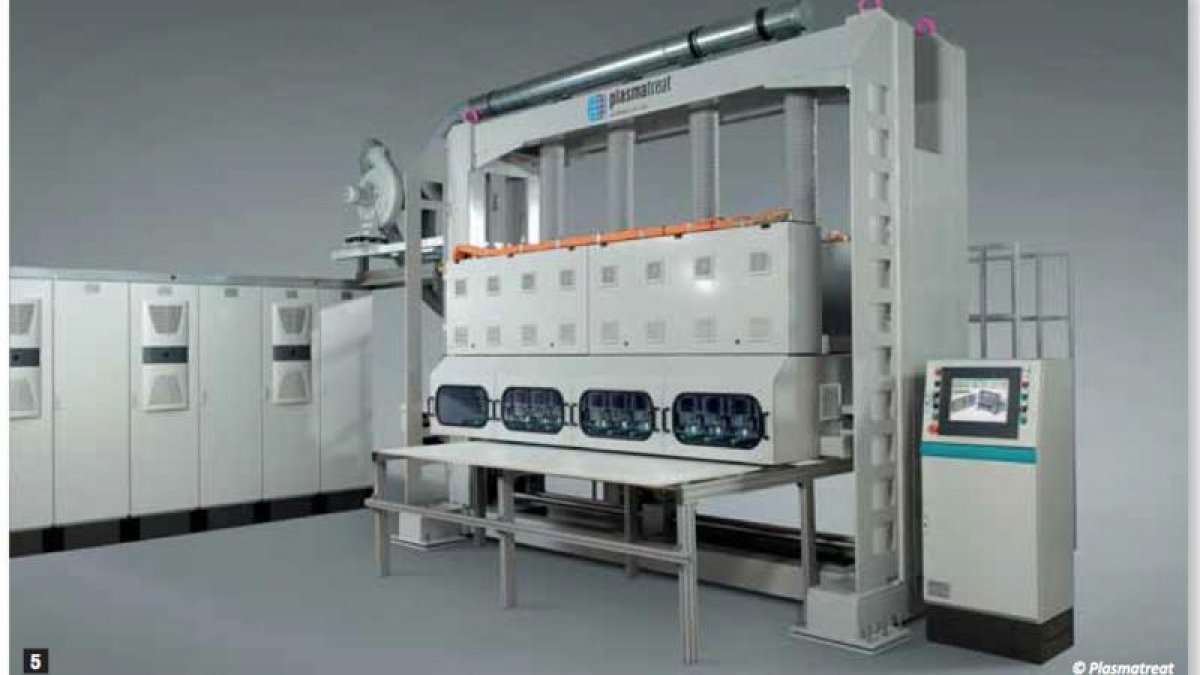
Plasmatreat presents an Openair atmospheric-pressure plasma jet surface pretreatment solution for large-format composite panels.
In-line plasma surface pretreatment for the production of large-format composite construction panels
To meet demand for plasma pretreatment of composite panels, Plasmatreat has set up and developed a new rotating nozzle method that, for the first time, allows panel manufacturers to pretreat large-format panels with potential-free atmospheric-pressure plasma at high production rates in a continuous process.
A high-tech solution for large surfaces and high speeds
Thanks to the new rotating nozzle technology developed by Plasmatreat, it is now possible for the first time to carry out in-line plasma pretreatment over a width of up to 3m, at very high treatment speeds of 25 m/min in continuous production. The system is equipped with 28 adjacent RD 1010 plasma nozzles, which are staggered in two rows and designed to allow the pretreatment of panels up to 3m wide.
The whole system can first be adjusted to the height at which the panels are to be pretreated. The panels are conveyed through the pretreatment system on a conveyor belt, with the possibility of precise adjustment for height differences of 1 mm within the plasma system. The system automatically detects the width of the panels to be pretreated and activates only the plasma nozzles suited to the current application.
The whole system has been designed to be user-friendly: the plasma nozzles can be adjusted to the desired height for maintenance, and it can be accessed via two bridges. The composition of lightweight honeycomb panels, for example, gives them a special structure that is unique in terms of strength and the amount of material required, all while offering minimal weight. So what could be more obvious than turning to natural, ecological solutions for industrial applications? Thanks to the new Openair plasma pretreatment solution developed by Plasmatreat, the narrow ribs of a plastic honeycomb can now be activated on a large scale without the need for a primer.
Flat lamination of composites
The term ?flat lamination? is commonly used to describe the bonding of several layers of material over a large surface. In general, bonding wood-based materials or PUR foam panels presents no problem.
However, things are different when it comes to bonding plastic-based panels, which are increasingly used and are generally made from PP or PVC. These plastic materials are expected to offer significant advantages, such as high stability and strength as well as low weight and water resistance. However, these plastics often have drawbacks in terms of processing. As non-polar resins, PP and PVC have an extremely low surface energy, which makes bonding practically impossible without additional surface activation. In the particular case of PVC, plasticizers remain on the surface and must absolutely be removed before bonding.
Activation of large surfaces of composite panels
For the production of such large polypropylene composite panels, Plasmatreat has developed and implemented the world's first system enabling the plasma pretreatment of PP panels for subsequent lamination or coating processes in a continuous production line.
With the new Openair plasma pretreatment system for large-format composite panels, the honeycomb core layer of a panel, or more precisely the narrow ribs of the plastic honeycomb, can now be activated over large surfaces without the need for any primer. For the facings bonded to the top and bottom of the honeycomb, stable long-term adhesion to the fine ribs of the structure is of paramount importance. Moreover, after plasma treatment, it is also possible to obtain a solid composite of the PP honeycomb core layer with facings made of materials such as steel.
