












Editorial team · Packing, Handling, Logistics
 InfoWeb Marketplace · Editorial team
Published on 24 February 2020 · 3 min read
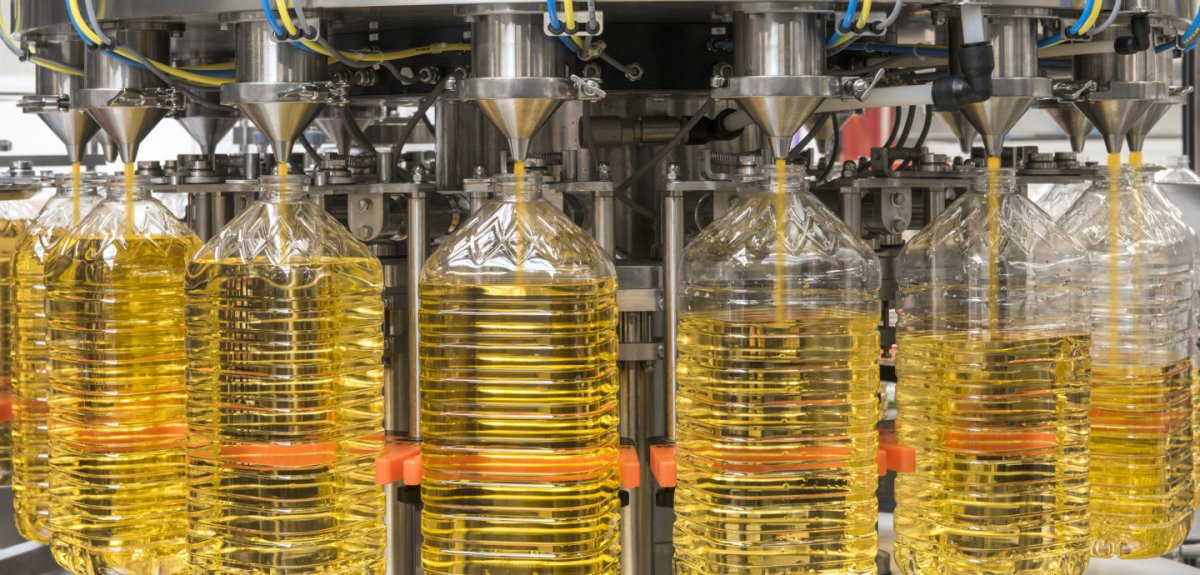
Producers wishing to switch from glass to PET bottles have two main options: machines linked by conveyors or integrated blow-fill-cap blocks. Serac, a major player in oil filling for more than 30 years and a supplier to the sector's leaders with 300 machines installed worldwide, including several in Spain at Borges and Ybarra, offers both. However, the market appears to be moving towards integrated blocks, which make it possible to lightweight the bottles as much as possible, are more compact and can be run by a single operator. These blocks also meet olive oil producers' requirements for output, cleanliness and dosing accuracy, thanks to Serac's weight-based filling technology.
On integrated blocks, the bottles are transferred by the neck from blowing to capping over a minimum distance and within an enclosed space. Eliminating traditional conveyors, on which bottles are pushed against one another in the open air, avoids the risk of external contamination and accidental tipping, particularly when bottles are accelerated or stopped.
In its integrated blocks, Serac brings all of its expertise in edible oil filling. Weight-based fillers dedicated to oils can in particular be equipped with vacuum nozzles that are conical in shape and open progressively. These nozzles significantly reduce disturbance at the bottom of the bottle and the aeration of the oil. Speeds can be increased without any risk of dripping, thus ensuring optimal bottle cleanliness. Serac is also able to run complex filling curves by varying the flow rate at the start, middle and end of filling: an advantage in particular for large formats, which can thus be filled faster while still remaining very clean.
For a product such as olive oil, whose volume varies with temperature and which is particularly affected by aeration, weight-based dosing remains the most accurate and reliable method: 1kg remains 1kg, whatever the volume. Serac has developed extremely accurate weight-based fillers (standard deviations between 0,3 and 0,5 g per 1 litre) which can moreover be approved for legal metrology (weights and measures). With these fillers, the quantity is right from the very first bottle produced and quality controls are reduced. Losses related to adjustment and overfilling are reduced, as are downtime and product changeover times.
To avoid overdosing, the quantity of oil that flows out after the nozzle closes must be perfectly controlled. On its fillers, Serac measures and adjusts it continuously. In addition, the bottle is never soiled thanks to the suction system of the vacuum nozzles, which draws the last drop back into a tank mounted above the tank bowl.
The medium- and high-speed blow-fill-cap blocks offered by Serac give olive oil producers the opportunity to reduce their production costs by integrating packaging manufacture on site without losing filling performance. They can produce bottles from 250 ml to 5 litres with all types of design, including added handles for the largest formats, and have been designed to offer maximum flexibility with reduced format changeover times at every stage. They can also integrate the eMC capping module, which makes it possible to insert a spray into the bottle for premium oils. As for Serac's weight-based filler-cappers, they remain a benchmark in the edible oil market, whatever the packaging (aluminium, glass, PET) and the speeds required.
Switching from Glass to PET Bottles for Olive Oil Filling
InfoWeb Marketplace · Editorial teamPublished on 24 February 2020 · 3 min read
An increasing number of olive oil producers are considering replacing glass bottles with PET bottles. Lighter, cheaper, less fragile and supported by well-organized recycling channels in many countries, PET has many advantages to offer. It is also well suited to new large-scale export markets. And several studies have shown that it is comparable to glass when it comes to preserving the organoleptic properties of the oil.
Olive oil filling
Producers wishing to switch from glass to PET bottles have two main options: machines linked by conveyors or integrated blow-fill-cap blocks. Serac, a major player in oil filling for more than 30 years and a supplier to the sector's leaders with 300 machines installed worldwide, including several in Spain at Borges and Ybarra, offers both. However, the market appears to be moving towards integrated blocks, which make it possible to lightweight the bottles as much as possible, are more compact and can be run by a single operator. These blocks also meet olive oil producers' requirements for output, cleanliness and dosing accuracy, thanks to Serac's weight-based filling technology.
Avoiding open-air conveying of uncapped bottles
On integrated blocks, the bottles are transferred by the neck from blowing to capping over a minimum distance and within an enclosed space. Eliminating traditional conveyors, on which bottles are pushed against one another in the open air, avoids the risk of external contamination and accidental tipping, particularly when bottles are accelerated or stopped.
Managing the filling speed
In its integrated blocks, Serac brings all of its expertise in edible oil filling. Weight-based fillers dedicated to oils can in particular be equipped with vacuum nozzles that are conical in shape and open progressively. These nozzles significantly reduce disturbance at the bottom of the bottle and the aeration of the oil. Speeds can be increased without any risk of dripping, thus ensuring optimal bottle cleanliness. Serac is also able to run complex filling curves by varying the flow rate at the start, middle and end of filling: an advantage in particular for large formats, which can thus be filled faster while still remaining very clean.
Using a dosing system that is insensitive to temperature and aeration
For a product such as olive oil, whose volume varies with temperature and which is particularly affected by aeration, weight-based dosing remains the most accurate and reliable method: 1kg remains 1kg, whatever the volume. Serac has developed extremely accurate weight-based fillers (standard deviations between 0,3 and 0,5 g per 1 litre) which can moreover be approved for legal metrology (weights and measures). With these fillers, the quantity is right from the very first bottle produced and quality controls are reduced. Losses related to adjustment and overfilling are reduced, as are downtime and product changeover times.
Perfectly controlling the drip tail
To avoid overdosing, the quantity of oil that flows out after the nozzle closes must be perfectly controlled. On its fillers, Serac measures and adjusts it continuously. In addition, the bottle is never soiled thanks to the suction system of the vacuum nozzles, which draws the last drop back into a tank mounted above the tank bowl.
The medium- and high-speed blow-fill-cap blocks offered by Serac give olive oil producers the opportunity to reduce their production costs by integrating packaging manufacture on site without losing filling performance. They can produce bottles from 250 ml to 5 litres with all types of design, including added handles for the largest formats, and have been designed to offer maximum flexibility with reduced format changeover times at every stage. They can also integrate the eMC capping module, which makes it possible to insert a spray into the bottle for premium oils. As for Serac's weight-based filler-cappers, they remain a benchmark in the edible oil market, whatever the packaging (aluminium, glass, PET) and the speeds required.
