












Editorial team · Robotics, Automation, Industrial IT
 InfoWeb Marketplace · Editorial team
Published on 15 February 2010 · 5 min read
Ulysse Nardin uses Maple to increase the power reserve of new watches
InfoWeb Marketplace · Editorial teamPublished on 15 February 2010 · 5 min read
Claude BOURGEOIS, consulting engineer and former researcher at CSEM (Swiss Center for Electronics and Microtechnology), used Maple to model and optimize an oxidized silicon balance wheel and hairspring resonator.
The use of composite materials for this application is expected to double the power reserve, i.e. the running time of watches at rest.
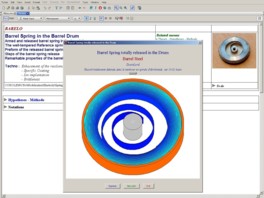
The architecture of mechanical watches, whether pocket or wrist watches, has long been based on the same principle. A flat spring (the mainspring) is wound inside a drum (the barrel).
The outer part of the spring rests against the inner face of the drum and is either rigidly fixed to it or attached by an elastic part. The central end of the spring is fixed to an axle (the barrel arbor).
By keeping the drum fixed and turning the barrel arbor, it is easy to see that the spring winds around the arbor and that potential energy can thus be stored in this system. With a cover to close the drum, you obtain the watch's driving element: the barrel.
As the dimensions of the spring and the drum are limited by the small space available in watches, the mechanical energy stored in the barrel is also limited.
The power reserve of the watch, i.e. the running time of the watch "at rest" - without any action by the user - depends essentially on this stored energy. In most cases, the power reserve of a wristwatch is around 48 hours.
If the energy storage density (ratio of stored energy to volume) can be maximized, the power reserve of the watch will also be increased.
This is why Ulysse Nardin, a pioneer in innovation using new technologies and new materials, launched the development of a mainspring made of composite materials with an elastic limit and resilience far superior to the best known steels.
The springs consist of a silicon core made on monocrystalline silicon wafers. This silicon core is then covered on its surface by the growth of a polycrystalline diamond coating.
Compared with steel, silicon and diamond show less fatigue. Moreover, such a spring should in principle make it possible to greatly increase the stiffness, the stored energy and the resilience of the mainspring.
Thus, for a given size, it is now estimated that the power reserve can be doubled. This could prove particularly relevant for small watches, notably ladies' watches, where the volume available for the barrel is restricted.
Another advantage comes from the use of deep reactive ion etching of silicon, a photolithographic process, which makes it possible to produce complex geometries.
Ongoing research at Ulysse Nardin therefore aims to produce a mainspring with a variable coil width so as to even out the transmitted torque. If the torque transmitted to the gear train is constant, the oscillation amplitude of the balance wheel will also be constant.
This eliminates the anisochronism phenomenon related to balance wheel amplitudes. The timekeeping accuracy of the watch can consequently be optimized.
Making several springs more than half a metre long on a silicon wafer limited to 6 inches in diameter (15.4 cm) imposes a limited footprint on the free spring (preform). This requires choosing a preform compatible with the tiling of the springs on the wafer, while imposing a variable thickness along the spring to obtain a constant torque.
To solve this challenge, Ulysse Nardin called on Claude Bourgeois, who developed a modeling and optimization tool based on the symbolic and numerical computation techniques that Maple makes possible.
First applications of silicon
The first applications of silicon (a very hard material with very low wear, an excellent friction coefficient, low inertia, and the possibility of making complex parts using silicon machining techniques with far greater precision than steel) were rigid components, fixed or moving, such as bearings, parts of the escapement, pinions, escape wheel, etc.
Then the elasticity of silicon was also put to use, at the very heart of the watch, in the hairspring associated with the balance wheel. To compensate for the strong intrinsic thermoelastic drift of silicon, which is incompatible with good timekeeping, Claude Bourgeois recommends thermal oxidation of the surface to offset this drift.
Today, Ulysse Nardin, in partnership with the company Sigatec, successfully uses this technology to produce its own temperature-compensated silicon hairsprings.
These new applications required new modeling tools, still uncommon in traditional watchmaking, to model, analyze and optimize these new types of active structures.
It turned out that symbolic computation techniques make it possible to simplify the models, which increases the computation speed, but above all makes analysis easier, and thereby the optimization of the systems.
This approach makes it easier to highlight the critical parameters linked to the desired function and the figures of merit of the system, and to establish analytical macromodels, which are useful for analysis and favorable to the emergence of new concepts.
Thus Maple's symbolic and mathematical computation software was chosen for modeling and optimizing the oxidized silicon balance wheel and hairspring resonator.
The program developed makes it possible to combine thermal drifts (up to the third order) and the anisotropy of silicon with the integration of the differential equations describing springs under large displacements, while taking into account the isochronism error of the resonator at the different amplitudes of the balance wheel.
The shape of the hairspring's terminal curve, which makes it possible to control isochronism errors, is then optimized by a convergent iterative calculation varying the most suitable geometric parameters.
Ulysse Nardin's Freak caliber
The first watch model to use this innovation is Ulysse Nardin's Freak caliber. The latter has an immense advantage: its barrel is placed beneath the rest of the movement. It thus occupies a large volume, as almost the entire diameter of the watch can be allocated to it. The power reserve of this watch thus reaches more than seven days.
Only one manual winding per week is thus necessary, by means of a fluted bezel located under the watch. Another special feature of this model is that the hour hand is fixed directly to the barrel drum, which deliberately makes one revolution every twelve hours. Finally, note that this watch is fitted with a carousel tourbillon, which guarantees great timekeeping accuracy.
Manufacture of silicon and diamond parts
Through its desire to innovate, the Ulysse Nardin manufacture now benefits from a highly advanced production tool drawn from its technological advances. Thus, the company Sigatec SA in Sion (Switzerland) was born from a joint venture between Ulysse Nardin and the company Mimotec SA, also in Sion, a manufacturer of nickel micro-parts.
Sigatec offers the possibility of manufacturing silicon parts on an industrial scale. The company Diamaze Microtechnology SA, based in La Chaux-de-Fonds (Switzerland), aims for its part to produce thin or thick layers of polycrystalline diamond.
For diamond mainsprings, it is Diamaze that coats the silicon core with diamond. A hard spring with a soft core is thus possible.
Advertisement