

Editorial team · Robotics, Automation, Industrial IT
 InfoWeb Marketplace · Editorial team
Published on 6 September 2011 · 3 min read
EPLAN - The new highlights of the Eplan Platform 2.0
InfoWeb Marketplace · Editorial teamPublished on 6 September 2011 · 3 min read
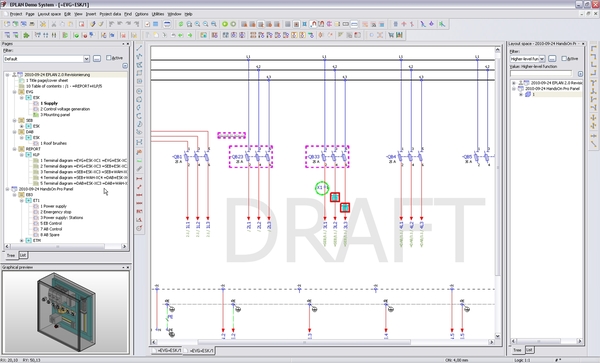
Six months have passed since the Eplan Platform 2.0 was launched on the market, and yet some of its 1000 extensions and more remain unknown. That is reason enough to explore this major release from surprisingly new perspectives and to get hands-on experience with the exciting and convincing logical extensions dedicated to schematic production, version management and language management.
The Machinery Directive and high quality requirements partly explain the growing attention paid to compliance with standards and regulations when creating schematics. The Eplan Platform has one and the same answer: standardization and repeated use. The required identifiers and additional component information can now be stored in parts management. The finishing touch for PE and N terminals: the designation of the required additional functions can be stored directly on the part. When the designer uses a component, its designation is automatically transferred to the schematic, ensuring that the terminal is displayed in compliance with standards on all schematic pages and without additional effort. Eplan's automatic functions for component numbering prevent duplication of device tags, which improves documentation quality and speeds up design.
More internal logic
Increasingly complex devices require a clear representation of the wiring in the schematic. This is where the Eplan Platform's possible transfer comes into play, now going beyond connections placed in the black box. By assigning a color code to connections based on internal interconnections, it is much easier to trace the signal. This applies throughout the entire process, from design and manufacturing through to commissioning and maintenance. More logic is also found in the properties of the elements, which can now contain detailed characteristics for display and conversion, even complete technical SI units. The same applies to reports and calculations, whose displayed values have been standardized. Eplan makes sure that all calculation values are displayed in the same units, regardless of how they were entered in the schematic. The accuracy of the results is a constant.
Perfect traceability of changes
Who hasn't experienced this situation? Just before a project is completed, numerous changes are made and must be traceable. The powerful version management included in the Eplan Platform 2.0 really comes into its own here, considerably speeding up change management. The different types of changes are clearly identified by means of colors and symbols. All project participants can see at a glance whether the project information has been added correctly. A table summarizing all changes ensures that all engineering processes, and above all manufacturing, commissioning and maintenance, run correctly. A direct consequence: faster start-up phases and shorter machine downtimes.
Centralized Eplan parts management
Here is a cost-effective alternative: those who store and centralize updates of parts data separately from engineering can now use Eplan parts management as a separate module. ?Centralized Parts Management? is a standalone version that provides a simple alternative for commercial departments. The information on the data and components created and entered here is accessible to all Eplan users. Thanks to this feature and the full parts management functionality, updating data proves simple and economical.
Language management
That Eplan is Unicode-compatible and can be used in 16 international languages is nothing exceptional in itself. What is new is the setting that allows the user to distinguish the source language from the display language in a project. The source language is the one in which the text was entered, usually the native language. The display language is the one in which the text appears in the schematic, sometimes several languages simultaneously. Text entry and translation management are even more transparent, and working with foreign languages in design is much easier.
A decisive asset for global operations, in terms of both time and quality.
Advertisement