
Faulhaber: millimeter-precise autonomous navigation with an AMR
 InfoWeb Marketplace · Editorial team
Published on 12 April 2022 · 5 min read
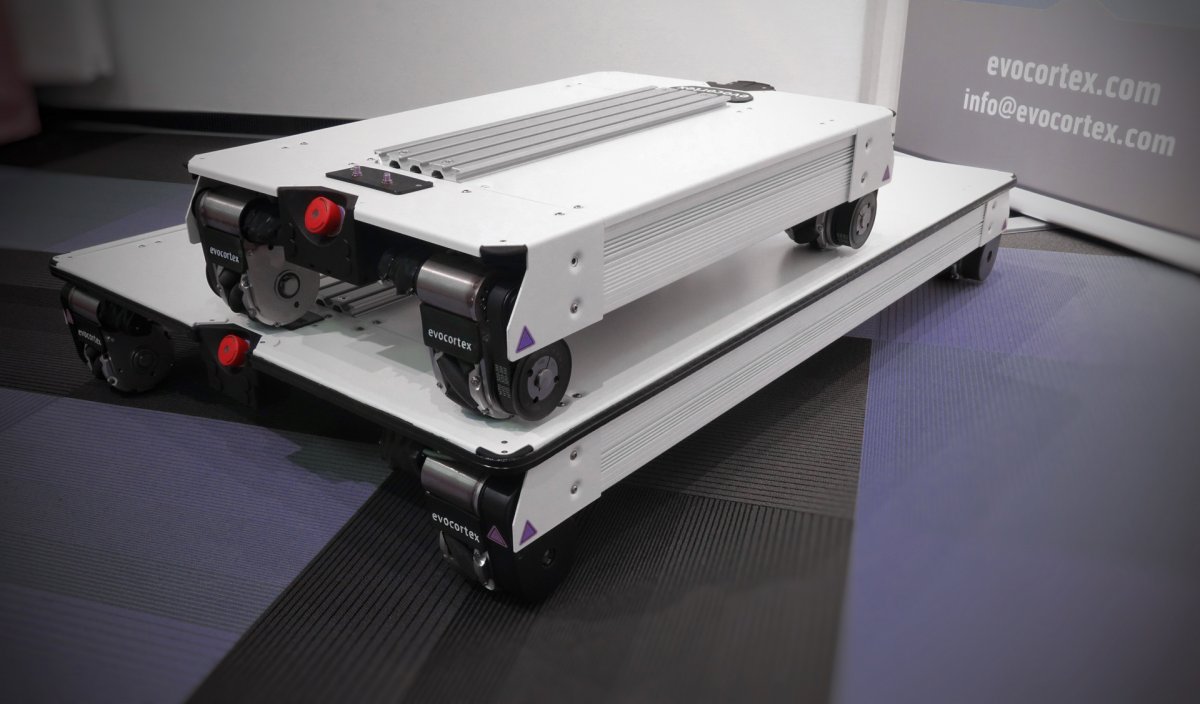
In the era of the Internet of Things (IoT) and Industry 4.0, intralogistics plays an increasingly important role. The precision with which materials and goods are transported is becoming a key factor for efficient production. Evocortex's mobile transport systems accomplish this task using unconventional means. Also decisive in implementing their creative technical concept: the power density of the FAULHABER motors used.
Today, "production" has become synonymous with "complexity". Products are increasingly manufactured to each customer's specifications; with IoT connectivity, fully automated production is already possible with a batch size of one. Such a diversity of variants requires closely interlinked yet highly flexible processes. The right parts and components - whose variability is almost infinite - must be ready at the right time at the various production stations.
AMRs are on the rise
The transport of materials, for example between supply points and production facilities, is therefore becoming increasingly individualized and at the same time must be carried out in as automated a manner as possible. Mobile robot platforms, known in industry as Autonomous Mobile Robots (AMRs), are therefore increasingly common in warehouses and production halls worldwide.
This market is the focus of the Nuremberg-based start-up Evocortex, which was founded in 2016 with the participation of experienced robotics experts. Closely linked to the nearby Nuremberg University of Technology as well as other educational and research institutions, the company entered the market with a brand-new AMR concept. With its products, it offers creative and novel solutions to meet the demands of modern intralogistics.
The warehouse floor's "fingerprint" indicates the exact position
Evocortex's Autonomous Mobile Robots (AMRs) need no pre-installed guidance system to recognize their location and find the right path. They simply orient themselves using the irregularities of the warehouse floor. Even ordinary smooth concrete floors have irregularities that are captured by the robot's high-resolution camera. This camera, located under the vehicle, captures an area of 10 x 10 centimeters and uses the image data to create a kind of fingerprint of the warehouse floor. Behind this sophisticated system is the localization module (ELM) developed by Evocortex.
During initial learning, the robot travels the entire warehouse following a grid. Using complex algorithms, a very precise map is built from a network of individual points. In the future, artificial intelligence should allow this map to be self-learning. In addition, the controller detects the vehicle's own movement. By combining the data, it can position the vehicle on a theoretical area of one square kilometer with millimeter-level precision.
Unlimited mobility with Mecanum wheels
A normal wheel only moves in the same direction as its axis. If you want to position a vehicle with such wheels precisely, you have to maneuver as if parking a car. To avoid this, Evocortex's developers opted for the Mecanum wheel. Instead of a closed tread, barrel-shaped rollers are mounted on its rim. They are fixed at an angle of 45 degrees to the wheel axis and rotate around their own oblique rolling axis. The shape, size and spacing of the rollers are such that they give the wheel a continuous rolling surface.
When the Mecanum wheel turns, two force components are created, one in the direction of rotation of the whole wheel and the other perpendicular to it. The resulting direction of movement lies between the two: the Mecanum wheel "wants" to move at an angle of 45 degrees to the direction of the axis. However, because of the mobility of the rollers, there is no directional rigidity. When other forces are applied in addition, the movement can be deflected in any direction.
On a vehicle with four Mecanum wheels, the 45-degree angles are each offset by 90 degrees. Each wheel therefore orients itself in a different direction. By varying the direction and rotation speed of each wheel, it is possible, from a standstill, to steer the vehicle in any direction or to make it turn on the spot. On the horizontal plane, it can move as freely as a hovercraft.
Millimeter-by-millimeter scalability thanks to Evocortex AMRs
Evocortex AMRs offer yet another dimension of flexibility: they can be manufactured in a virtually unlimited number of sizes. "If needed, we can adapt our robot to our customers' wishes to the millimeter," emphasizes Hubert Bauer. "Between 400 by 480 and 800 by 1200 millimeters, all external dimensions are possible." In the case of the EvoRobot R&D and EvoRobot Industrial product lines, these dimensions also roughly correspond to the external dimensions of the load-bearing platform. All of the technology - sensors, controller, lifting unit and wheel drive - is mounted under the platform.
The wheel drive module is a decisive element for this scalability. Located directly above each wheel, it forms with it a standardized, independent functional unit.
"We examined very carefully the motors available on the market that could be considered for this," recalls Huber Bauer about the development phase. "Only at FAULHABER did we find the power density we need. Competitors' motors would have required more space for the required torque."
EvoRobot, enormous power in minimal volume
The EvoRobot's wheel modules are equipped with DC motors from the 3257...CR or 3272...CR series. Each has an encoder IEF3 and a gearhead 38/2 S. The wheel motors are also equipped with a brake for a quick stop and to ensure that the wheels remain locked in position once stopped. "Thanks to the enormous power of these small motors, the EvoRobot is able to transport loads of up to 200 kilograms, and soon even more," explains Huber Bauer. "Transport works even on a ramp inclined at five degrees and at a speed of one meter per second."
The EvoCarrier product line is designed for transporting small-parts bins. Inside this AMR, space is even more restricted than in the EvoRobot. The robot is less than 100 mm high. It can therefore move into extremely low openings beneath a transported load. Two or four EvoCarriers can also work together to transport pallets or an entire shelving unit. For the drive, the developers chose a so-called "flat rotor" motor, a brushless motor from the 4221... BXT series with a length of only 21 millimeters. The EvoCarrier can thus transport stacks of small-parts bins (KLT) on casters weighing up to 120 kilograms in total. In the longer term, the Managing Director believes that the EvoRobot will probably also switch to brushless motors and that the standardization of the modules will continue.