
Editorial team · Machine tools
 InfoWeb Marketplace · Editorial team
Published on 17 May 2011 · 4 min read
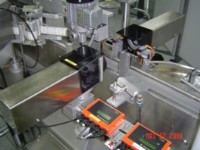
Keyence vision systems
InfoWeb Marketplace · Editorial teamPublished on 17 May 2011 · 4 min read
At its Evreux plant, GlaxoSmithKline, seeking to improve its manufacturing processes, needed to upgrade the vision system on its high-speed marking lines. The previous system required automatic verification to be deactivated, which forced the plant to have operators carry out the inspection. Not only is the Keyence solution reliable, but it is also much cheaper than those of its competitors.
The vision system used to inspect the marking consists of 3 cameras. "The first is involved in the most delicate phase, as it must read black laser marking on plastic cases of different colors - 4 for four different molecules. While reading is fairly easy on green or orange, it proves complex on blue or purple, which offer limited contrast," explains Sylvain Bouckenooghe, project manager.
The solution was to apply specific lighting: "We went directly to Keyence, who found a solution to our problems. The sales engineer proposed the necessary settings, including for the lighting. Keyence then lent us the equipment, which allowed us to see immediately that it worked perfectly. Since then, one million parts have passed through in 4 months on 3/8, without the slightest failure."
The second camera checks the placement of a label, both in terms of concentricity and position, with a tolerance of approximately 0,3 mm, while the last camera reads a label to check that the expiry date is correctly indicated. For this, the vision system uses an integrated OCR.
Power serving detection reliability
"We knew from the start that the system was more than powerful enough for our production rates. What we are very satisfied with, however, is the stability of detection. In the pharmaceutical industry, it is even more demanding, because we cannot accept 99,99% reliability, only 100%," adds Sylvain Bouckenooghe.
Keyence's CV-5000 is the most powerful standalone vision system on the market. It can, for example, process 1 million pixels in 20,5 ms. This computing power also makes production inspection more reliable: its repeatability is the highest on the market (7x higher than current standards) and numerous image processing functions are available to optimize inspection accuracy.
In addition, 18 inspection functions are offered. They meet the needs of the most demanding vision applications (including the Shape Trax modes and OCR).
The models in the CV-5000 series are driven by a high-speed color image processing engine and a high-speed RISC central unit (reduced instruction set computer) combined with two DSP (digital signal processors) dedicated to image processing.
Overall, the models in the series use four processors to achieve parallel processing and the highest possible processing speed. The central unit and the DSP processors make it possible to reach twice the speed of the best existing models on the market.
A very economical and high-performance solution
"We launched a tender and were surprised to find that the Keyence offer was three times cheaper," explains Sylvain Bouckenooghe. "The difference is explained by the fact that our cameras are much easier to integrate. Keyence France includes the service in its price, so even with similar hardware costs, we are much cheaper," explains Alexandre BONY, Vision Product Manager at Keyence France.
"Implementation took only 4 days. Project management was relatively simple. Our experience with vision systems allowed us to quickly identify the key points so as not to waste too much time or energy on details," adds Sylvain Bouckenooghe.
The CV-5000 series has functions that make implementation easier. For example, a lighting adjustment automatically restores the brightness of a captured image to that of the pre-recorded reference image. This avoids anomalies caused by deteriorating lighting and variations in outside light. In addition, up to 16 types of filters can be defined per window (anti-glare, color processing, etc.).
Finally, the CV-5000 series is a multi-camera system: up to 4 cameras can be connected to the controller from a choice of 12 cameras, which is the widest choice on the market. This is economically advantageous when the inspection involves several cameras. This configuration also allows large industrial sites to implement highly consistent solutions, which are therefore simpler and more economical to install and maintain. Among these cameras, color CCD models with 2 million pixels or 5 million pixels are available (the highest on the market).
These cameras can process a total of 2 million pixels in a single operation. High-speed 7x CCD cameras in the CV-5000 series are also offered. They are the fastest in their category and adapt easily to ultra-fast lines and continuous part production. The 1 million pixel camera models can perform processing in about the same time as standard 240 000 pixel models.
An open system
"We prefer to have control over the inspection equipment. We did not want a black box like other systems offered on the market. This is a strong point of the Keyence solution, because we have the means to modify internal parameters or add inspection tools simply, without going through the supplier. This way we avoid extra costs after commissioning," concludes Sylvain Bouckenooghe.
The CV-5000 series offers maximum connectivity: digital I/O, Ethernet port, USB and RS-232... Interfacing with the PLC was immediate. It is of course used to eject non-conforming products from the production line.
The vision system used to inspect the marking consists of 3 cameras. "The first is involved in the most delicate phase, as it must read black laser marking on plastic cases of different colors - 4 for four different molecules. While reading is fairly easy on green or orange, it proves complex on blue or purple, which offer limited contrast," explains Sylvain Bouckenooghe, project manager.
The solution was to apply specific lighting: "We went directly to Keyence, who found a solution to our problems. The sales engineer proposed the necessary settings, including for the lighting. Keyence then lent us the equipment, which allowed us to see immediately that it worked perfectly. Since then, one million parts have passed through in 4 months on 3/8, without the slightest failure."
The second camera checks the placement of a label, both in terms of concentricity and position, with a tolerance of approximately 0,3 mm, while the last camera reads a label to check that the expiry date is correctly indicated. For this, the vision system uses an integrated OCR.
Power serving detection reliability
"We knew from the start that the system was more than powerful enough for our production rates. What we are very satisfied with, however, is the stability of detection. In the pharmaceutical industry, it is even more demanding, because we cannot accept 99,99% reliability, only 100%," adds Sylvain Bouckenooghe.
Keyence's CV-5000 is the most powerful standalone vision system on the market. It can, for example, process 1 million pixels in 20,5 ms. This computing power also makes production inspection more reliable: its repeatability is the highest on the market (7x higher than current standards) and numerous image processing functions are available to optimize inspection accuracy.
In addition, 18 inspection functions are offered. They meet the needs of the most demanding vision applications (including the Shape Trax modes and OCR).
The models in the CV-5000 series are driven by a high-speed color image processing engine and a high-speed RISC central unit (reduced instruction set computer) combined with two DSP (digital signal processors) dedicated to image processing.
Overall, the models in the series use four processors to achieve parallel processing and the highest possible processing speed. The central unit and the DSP processors make it possible to reach twice the speed of the best existing models on the market.
A very economical and high-performance solution
"We launched a tender and were surprised to find that the Keyence offer was three times cheaper," explains Sylvain Bouckenooghe. "The difference is explained by the fact that our cameras are much easier to integrate. Keyence France includes the service in its price, so even with similar hardware costs, we are much cheaper," explains Alexandre BONY, Vision Product Manager at Keyence France.
"Implementation took only 4 days. Project management was relatively simple. Our experience with vision systems allowed us to quickly identify the key points so as not to waste too much time or energy on details," adds Sylvain Bouckenooghe.
The CV-5000 series has functions that make implementation easier. For example, a lighting adjustment automatically restores the brightness of a captured image to that of the pre-recorded reference image. This avoids anomalies caused by deteriorating lighting and variations in outside light. In addition, up to 16 types of filters can be defined per window (anti-glare, color processing, etc.).
Finally, the CV-5000 series is a multi-camera system: up to 4 cameras can be connected to the controller from a choice of 12 cameras, which is the widest choice on the market. This is economically advantageous when the inspection involves several cameras. This configuration also allows large industrial sites to implement highly consistent solutions, which are therefore simpler and more economical to install and maintain. Among these cameras, color CCD models with 2 million pixels or 5 million pixels are available (the highest on the market).
These cameras can process a total of 2 million pixels in a single operation. High-speed 7x CCD cameras in the CV-5000 series are also offered. They are the fastest in their category and adapt easily to ultra-fast lines and continuous part production. The 1 million pixel camera models can perform processing in about the same time as standard 240 000 pixel models.
An open system
"We prefer to have control over the inspection equipment. We did not want a black box like other systems offered on the market. This is a strong point of the Keyence solution, because we have the means to modify internal parameters or add inspection tools simply, without going through the supplier. This way we avoid extra costs after commissioning," concludes Sylvain Bouckenooghe.
The CV-5000 series offers maximum connectivity: digital I/O, Ethernet port, USB and RS-232... Interfacing with the PLC was immediate. It is of course used to eject non-conforming products from the production line.
Advertisement