
Editorial team · Robotics, Automation, Industrial IT
 InfoWeb Marketplace · Editorial team
Published on 3 June 2010 · 3 min read
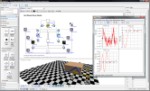
MapleSim
InfoWeb Marketplace · Editorial teamPublished on 3 June 2010 · 3 min read
MapleSim is used to develop the high-fidelity, multi-domain model of an automated ground-based space exploration vehicle
Exploring planets with unmanned vehicles is a priority for many space agencies around the world. To carry out this type of program, highly advanced autonomous robotic rovers are required.
Prof. Amir Khajepour, Director of the Mechatronic Vehicle Systems research chair and Professor of Engineering in the Department of Mechanical and Mechatronics Engineering at the University of Waterloo (UW), is working with the Canadian Space Agency (CSA), Maplesoft and the Government of Canada to develop a complete power management solution for autonomous rovers. Thanks to MapleSim, the foundation of the mathematical model of the 6-wheeled rover was developed in barely a month and without having to write a single equation.
The CSA has long used symbolic techniques for modeling in the field of space robotics. In particular, it uses these techniques to design various space robots for the Space Shuttle program and the International Space Station. This new University of Waterloo (UW) project uses MapleSim, the latest generation of symbolic modeling tools, to develop in a short time the high-fidelity multi-domain models used by the rover's subsystems.
The overall objective of the project is to design a system capable of driving the rover from point A to point B while taking into account all probable issues and constraints. For example, which route should the rover choose to reach a given location while taking the least risk?
Or while consuming as little energy as possible?
The first stage of this project, planned over 3 years, is to develop the initial model of the rover, taking into account all of its characteristics, including its batteries, its solar power system, and terrain and soil conditions.
In its later stages, the project will also include a complete series of ?Hardware-in-the-Loop? (HIL) test phases using real-time hardware and software components from National Instruments and system models developed and automatically deployed by MapleSim. This stage is essential for optimizing the system parameters in order to maximize the vehicle's energy conservation without affecting its assigned missions in any way.
?MapleSim allowed us to develop the rover's base model in barely a month,? says Prof. Khajepour. ?The advantages of MapleSim over traditional tools are considerable. We were able to build the mathematical model of our 6-wheeled rover without writing a single equation. MapleSim automatically generated an optimal number of equations, which is a key asset in the optimization phase.?
Prof. Khajepour particularly appreciated MapleSim's graphical interface, which makes it easy to recreate the system diagram on screen using components that represent the physical model. The resulting system diagram is very similar to the drawing an engineer would have sketched by hand. MapleSim can then realistically animate these models. These animations greatly facilitate validation of the system diagram and provide a better understanding of its behavior.
?Visualizing the model and the operation of moving parts is a very important advantage for a developer,? explains Prof. Khajepour. ?That is why I am gradually adopting MapleSim for most of the projects I handle.?
MaplesoftTM is the leading provider of high-performance software tools for engineering, science and mathematics.
Maplesoft's core technologies include the world's most powerful symbolic computation engine and revolutionary physical modeling techniques. Combined, these technologies enable the creation of advanced tools for high-performance design, modeling and simulation.
Maplesoft products help reduce errors, shorten design times, lower costs and improve results. The Maplesoft product suite includes Maple, the technical computing and documentation environment, and Maplesim, the high-performance multi-domain modeling and simulation tool for physical systems.
Engineers, scientists and mathematicians use Maplesoft products to work better, faster and smarter.
Maplesoft's customers include Ford, BMW, Bosch, Renault, Volvo Trucks, Boeing, NASA, Canadian Space Agency, Canon, Motorola, Microsoft Research, Bloomber and DreamWorks, covering industrial sectors such as automotive, aerospace, electronics, defense, energy, finance, consumer goods and the leisure industry.
With Toyota, Maplesoft founded the ?Plant Modeling Consortium? (PMC) to promote the development of new design techniques for the automotive and related industries.
Advertisement