
Renault uses Maple mathematical software to estimate the risk of engine seizure
 InfoWeb Marketplace · Editorial team
Published on 27 September 2010 · 3 min read
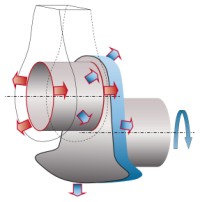
The Powertrain Division of Renault has developed a predictive seizure model, of the 0D-1D type, based on Maple. The manufacturer thus avoids additional costs, estimated at between 1 and 2 million euros, when the first prototype of an engine exhibits seizure behavior.
All of the models consider two cylindrical mechanical surfaces in a mixed lubrication regime.
The physical phenomena involved are very complex:
-Lubrication (thin viscous rough film equations at low Reynolds number)
-Cavitation (phase change in the oil film)
-Non-Newtonian fluids (piezoviscosity and shear rate effect)
-Wall elasticity coupling
-Oil shearing (heating)
-Microcontacts generating friction (heating by microcontacts)
-Conduction and forced convection (thermofluid)
The model is built by describing all of these phenomena from their equations in the
Maple software. In this respect, some of the equations describing the thermal aspects are shown in figure 2.
Writing the equations is greatly facilitated by Maple's technical document interface, which allows
the natural writing of mathematical expressions.
The parametric model built with Maple makes it possible to predict the risks of seizure and to better understand its mechanism. The ?overheating? and the resulting seizure occur in a very short time, but it is also important to understand the conditions that lead to the ?overheating?, sometimes over long periods. The 0D/1D model built with Maple also makes it possible to build seizure maps as a function of multiple parameters. More generally, it makes it possible to predict seizure behavior for a given set of parameters.
?The parametric model built with Maple makes it possible to capture more physics in the modeling of phenomena and thus provide answers where conventional codes provide nothing,? says Mr. Ligier, R&D Manager at the Powertrain Division of Renault. ?This approach allows rapid iterations to build maps or sensitivity analyses and to respond, in very short timeframes, to the new challenges that any competitive industrial development must meet.?
Maple software is commonly used within the Powertrain Division of Renault for 0D/1D modeling of system physics. With this approach, relevant technical recommendations can be proposed in a very short time across a very wide range of applications.
The seizure phenomenon can occur in many complex mechanical systems. It results from a strong thermal imbalance between the energy supplied and the energy dissipated and takes different forms, such as a sudden increase in the friction coefficient, heating and destruction of the mechanical parts in contact, and/or blocking of the movements of the mechanical system.
Avoiding this type of failure is a major challenge for designers of combustion engines, particularly at automobile manufacturers. When the first prototype exhibits seizure behavior, it causes very significant delays and additional costs.
Typically 1 to 2 million euros for a prototype engine and the tests, not counting the additional costs caused by project delays, which increase sharply as series production approaches.
The causes of a system's seizure can be multiple: clearance too small, clearance too large, aggressive surface, contamination... One thing is certain: a model that can predict seizure and help make design recommendations is a critical asset for the designer.
The objective of this model is to describe the overall physical behavior of a lubricated mechanical system, by calculating the behavior of the system at a limited number of points and for the physical quantities necessary to predict seizure.
This type of modeling, also called 0D-1D modeling, focuses on describing physical behavior as a function of time. (To be more rigorous, we should speak of dynamic systems.) Unlike detailed models, such as finite elements, they allow good physical interpretation of the results and also offer much more powerful and faster optimization possibilities.
The model developed by Renault consists of two parts. The first part is used to build data tables from an already existing lubrication model. The second part deals with aspects relating to thermal behavior, based on the tables mentioned above.
Physically, MaplesoftTM is the leading provider of high-performance software tools for engineering, science and mathematics.
Maplesoft's core technologies include the world's most powerful symbolic computation engine and revolutionary physical modeling techniques. When combined, these technologies enable the creation of advanced tools for high-performance design, modeling and simulation.
Maplesoft products help reduce errors, shorten design times, lower costs and improve results. The Maplesoft product suite includes Maple, the technical computing and documentation environment, as well as Maplesim, the high-performance multi-domain modeling and simulation tool for physical systems.
Engineers, scientists and mathematicians use Maplesoft products to work better, faster and smarter.