

Description
WorkNC Roughing 3+2 axes
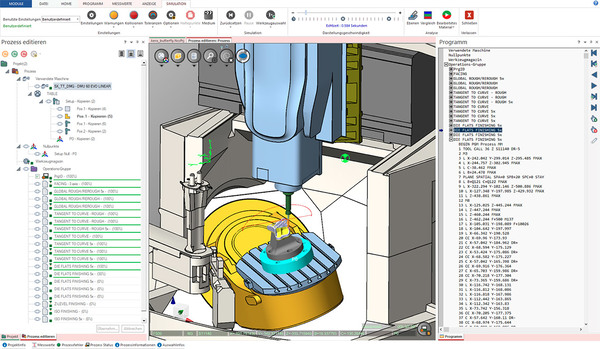
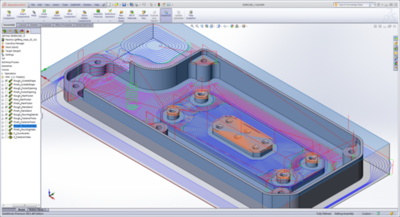
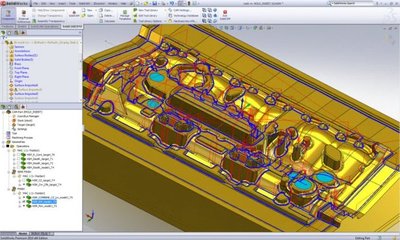
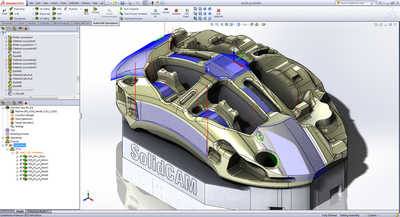
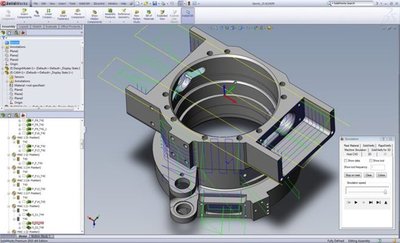
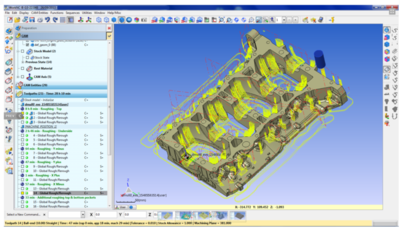
Roughing and re-roughing toolpaths are among the fundamental strategies of WorkNC. The roughing toolpaths of a productive CAM system must allow users to considerably reduce machining times.
WorkNC roughing strategies generate toolpaths with few unnecessary movements, localized clearances, a UGV smoothing radius, and the removal of ramp engagements when they are not needed.
Overview of features
High-performance toolpath generation
Tool holder collision prevention
Smoothed trajectories for high-speed machining
One-click control of the Z machining plane
Extensive range of stock models
3+2 axis stock generation for intelligent roughing.
Thanks to its dynamic stock management, WorkNC automatically determines the areas where material must be removed. Because it takes the tool and tool holder into account to allow a dynamic update of the roughing toolpath and collision control regardless of tool length, dynamic stock management makes machining even more reliable.
An accurate stock model improves roughing quality. WorkNC offers 5 types of stock models to cover every type of application (solid block, user-defined cylindrical or cubic block, casting, surface offset, and CAD model). You are never short of a solution for roughing a part.
The efficiency of re-roughing toolpaths is constantly improved, and WorkNC is capable of machining undercut areas with 3+2 axis toolpaths. This is made possible by a constantly updated 3D model, allowing re-roughing toolpath sequences with progressively smaller tools on the remaining stock.
Roughing toolpaths ensure smooth movements and cutting conditions, automatically optimized to require a minimum of manual setup. All of this has been designed so that WorkNC guarantees very high-performance machining and a long service life for the tool and the machine.
Global roughing/re-roughing
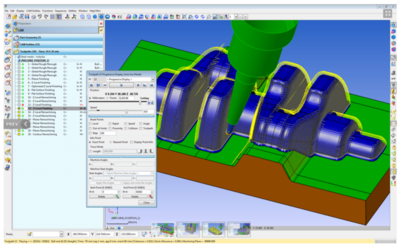
The global roughing/re-roughing toolpath is performed on a stock model to optimize cutting conditions. It is the strategy most commonly used in many applications.
It is optimized to reduce the number of unnecessary tool movements, to perform only localized clearances and corner smoothing suited to high-speed machining, automatic detection, and the machining of flat surfaces. All of this ensures consistent stock levels.
Thanks to its dynamic stock management function, the global re-roughing strategy automatically determines the areas where material must be removed.
In addition, this toolpath is capable of machining a large quantity of material in a single pass thanks to high stepover values (up to 95 % of the tool diameter) and high Delta Z values. An initial stepover can be specified to ensure that the tool load is not excessive during the first pass at each level. This is useful when the "actual" stock is not quite the same size as the theoretical stock.
Such optimization of the machining toolpath delivers significant productivity gains.
Roughing/re-roughing flat surfaces
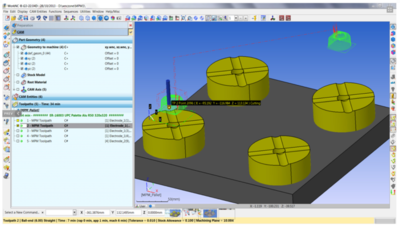
As its name indicates, this toolpath is intended for flat surfaces. It is particularly useful for roughing these areas (and even removing all the stock) with progressively smaller tools, where stock is only left in narrow corners. It automatically detects the areas to be machined while ignoring stock on inclined side walls.
It is mainly used after an initial roughing pass, complementing it. It uses the same tools but concentrates only on the flat/vertical parts, with a constant feed rate and material removal with spiral engagements.
Adaptive trochoidal roughing (machining hard materials)
This toolpath is recommended when machining hard materials and/or when machining with a large Delta Z.
This toolpath guarantees optimal machining conditions thanks to a trochoidal trajectory when the tool is in full material and contour machining as soon as the engagement allows. It is designed to limit the load on the tool in certain areas such as pockets and corners. Machining is also performed in climb milling, thus preserving the tools. It is also possible to incorporate re-roughing passes with a smaller Delta Z and the same tool within the same toolpath.
Thanks to the WorkNC dynamic stock management function, this toolpath is a real innovation in terms of optimization and productivity.
Punch/spiral roughing
This toolpath is recommended for machining punch-type parts, or for machining from the outside toward the inside. It is also used with a high feed rate to machine hard materials.
The generated trajectories are spiral-shaped with a single pass per level, in order to ensure smooth tool movements.
Plunge roughing
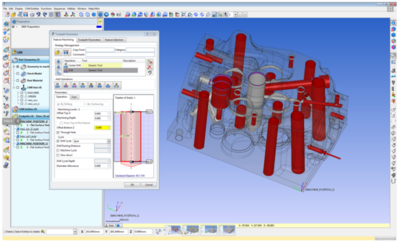
This toolpath is ideal for quickly removing large quantities of material, especially on large parts.
WorkNC users report machining time reductions of more than 50 % thanks to this strategy.
It is particularly well suited to conventional machines because the load is exerted through the spindle, with reduced radial load, deformation, and spindle wear.
It benefits from a high material removal rate due to the large stepdown compared with more traditional methods, a choice of finishing quality, 3 cutting actions depending on the tool type, and a fast calculation time.
Roughing and re-roughing toolpaths are among the fundamental strategies of WorkNC. The roughing toolpaths of a productive CAM system must allow users to considerably reduce machining times.
WorkNC roughing strategies generate toolpaths with few unnecessary movements, localized clearances, a UGV smoothing radius, and the removal of ramp engagements when they are not needed.
Overview of features
High-performance toolpath generation
Tool holder collision prevention
Smoothed trajectories for high-speed machining
One-click control of the Z machining plane
Extensive range of stock models
3+2 axis stock generation for intelligent roughing.
Thanks to its dynamic stock management, WorkNC automatically determines the areas where material must be removed. Because it takes the tool and tool holder into account to allow a dynamic update of the roughing toolpath and collision control regardless of tool length, dynamic stock management makes machining even more reliable.
An accurate stock model improves roughing quality. WorkNC offers 5 types of stock models to cover every type of application (solid block, user-defined cylindrical or cubic block, casting, surface offset, and CAD model). You are never short of a solution for roughing a part.
The efficiency of re-roughing toolpaths is constantly improved, and WorkNC is capable of machining undercut areas with 3+2 axis toolpaths. This is made possible by a constantly updated 3D model, allowing re-roughing toolpath sequences with progressively smaller tools on the remaining stock.
Roughing toolpaths ensure smooth movements and cutting conditions, automatically optimized to require a minimum of manual setup. All of this has been designed so that WorkNC guarantees very high-performance machining and a long service life for the tool and the machine.
Global roughing/re-roughing
The global roughing/re-roughing toolpath is performed on a stock model to optimize cutting conditions. It is the strategy most commonly used in many applications.
It is optimized to reduce the number of unnecessary tool movements, to perform only localized clearances and corner smoothing suited to high-speed machining, automatic detection, and the machining of flat surfaces. All of this ensures consistent stock levels.
Thanks to its dynamic stock management function, the global re-roughing strategy automatically determines the areas where material must be removed.
In addition, this toolpath is capable of machining a large quantity of material in a single pass thanks to high stepover values (up to 95 % of the tool diameter) and high Delta Z values. An initial stepover can be specified to ensure that the tool load is not excessive during the first pass at each level. This is useful when the "actual" stock is not quite the same size as the theoretical stock.
Such optimization of the machining toolpath delivers significant productivity gains.
Roughing/re-roughing flat surfaces
As its name indicates, this toolpath is intended for flat surfaces. It is particularly useful for roughing these areas (and even removing all the stock) with progressively smaller tools, where stock is only left in narrow corners. It automatically detects the areas to be machined while ignoring stock on inclined side walls.
It is mainly used after an initial roughing pass, complementing it. It uses the same tools but concentrates only on the flat/vertical parts, with a constant feed rate and material removal with spiral engagements.
Adaptive trochoidal roughing (machining hard materials)
This toolpath is recommended when machining hard materials and/or when machining with a large Delta Z.
This toolpath guarantees optimal machining conditions thanks to a trochoidal trajectory when the tool is in full material and contour machining as soon as the engagement allows. It is designed to limit the load on the tool in certain areas such as pockets and corners. Machining is also performed in climb milling, thus preserving the tools. It is also possible to incorporate re-roughing passes with a smaller Delta Z and the same tool within the same toolpath.
Thanks to the WorkNC dynamic stock management function, this toolpath is a real innovation in terms of optimization and productivity.
Punch/spiral roughing
This toolpath is recommended for machining punch-type parts, or for machining from the outside toward the inside. It is also used with a high feed rate to machine hard materials.
The generated trajectories are spiral-shaped with a single pass per level, in order to ensure smooth tool movements.
Plunge roughing
This toolpath is ideal for quickly removing large quantities of material, especially on large parts.
WorkNC users report machining time reductions of more than 50 % thanks to this strategy.
It is particularly well suited to conventional machines because the load is exerted through the spindle, with reduced radial load, deformation, and spindle wear.
It benefits from a high material removal rate due to the large stepdown compared with more traditional methods, a choice of finishing quality, 3 cutting actions depending on the tool type, and a fast calculation time.
Technical specifications
| Category | Robotics, Automation, Industrial IT |
|---|---|
| Subcategory | Industrial software |